The Trigon (3)

A confident woman giving an engaging lecture in a modern university lecture hall, standing at a podium with a presentation screen behind her, attentive audience in the foreground, warm professional lighting, realistic editorial photography style

So why did humanity use this particular symbol to represent support for The Emperor?

Well, I can think of two major points.

A triangle, by its very nature, has three points. One point is The Emperor, another is his subjects, and the final point is his armies. It is a covenant between each that forms The Empire.

The second reason is this. If you follow the sides of a triangle, you never reach an end. You are in perpetual, unending motion. Similarly, the Empire will have no end. There will always be The Emperor. As he has declared, he will outlive the Universe itself. It is not for us to question how.

The Trigon is now integral to the Empire. It is the first symbol to be put on the civic buildings of a newly conquered world or at the centre of the first settlement in a new colony.

Ladies and Gentlemen, it was a pleasure speaking to you today. A reminder: extreme heat expected later today. Take care, and may The Emperor bless you all.

The Trigon

A breathtaking high-resolution astronomical view of the Milky Way galaxy seen edge-on from deep space, with luminous spiral structure, dense star fields, glowing blue and gold nebulae, dark dust lanes, and a richly detailed cosmic backdrop. Scientific yet awe-inspiring, realistic astrophotography style, no text, no spacecraft, no people.

This was when the first instance of the triangle symbol becoming synonymous with The Emperor. It became a way to demarcate oneself as loyal to The Emperor. A simple triangle on your door, wall or even cut into the grass to be seen from above.

One Government forces were harassed and harangued through the countryside and even in the cities. Gradually, the tide turned. A major turning point was the removal of the Devils Guard to the collapsing Chinese front.

Over the next couple of months, Spain was conquered and the march into central Europe began. Now, The Trigon became more prominent. It was put on the uniforms of the soldiers and marked clearly on the armored vehicles.

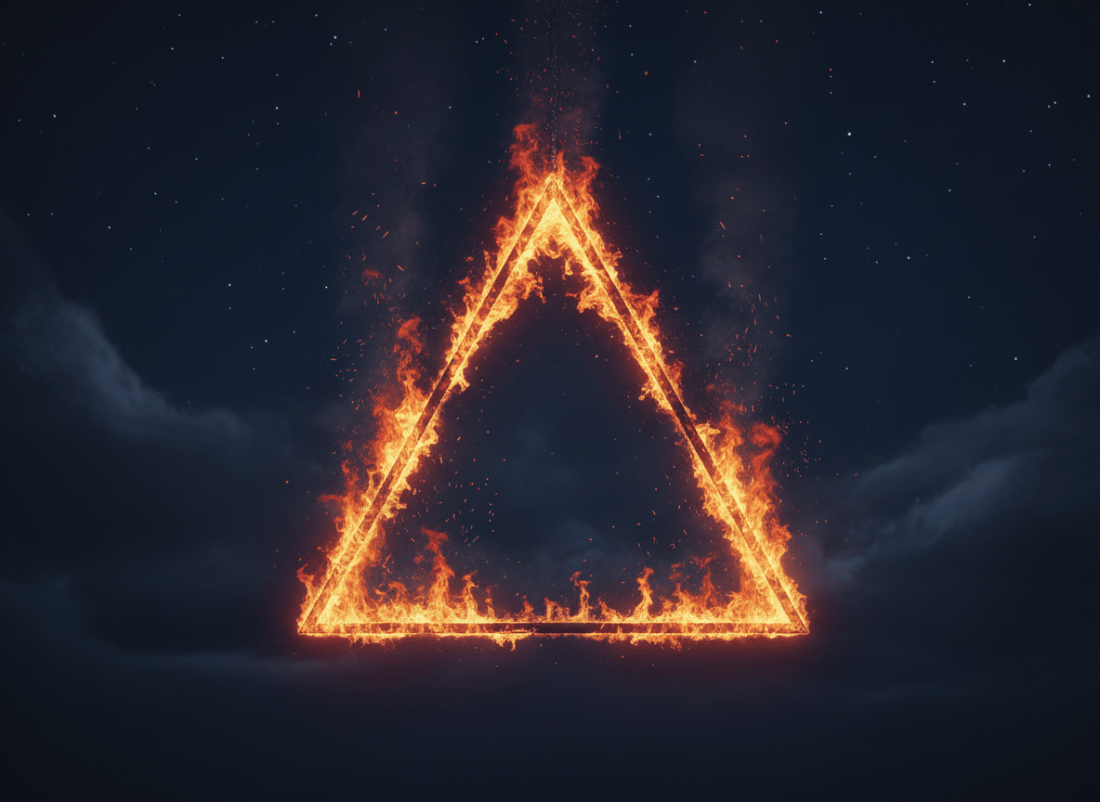
It reached its zenith at the battle of Brussels. A triangle of fire against a black background became the flag of the Emperor’s forces

After the Emperor triumphed, the Trigon as became known was added to the buildings of religious institutions. Some were made of wood, others of gold. For a time, they larger before size was no longer seen as important. It was the Sisters of Vengeance that started using it as an instrument of prayer, bringing The Trigon throughout the Empire.

To be continued.

The Trigon

A dramatic burning triangle suspended in a deep midnight-blue night sky, its three edges glowing with intense orange and red flames, sparks and wisps of smoke rising upward, subtle stars and clouds in the background, dark atmospheric fantasy style, cinematic lighting, highly detailed, no text.

The following is an extract from a lecture by Dr. Lena Hall, a visiting professor from Harvard to an audience in Dhaka University in 235 EY. The title of the lecture was called “The Trigon – Symbolism, Eternal Power and the Emperor”.

Ladies and Gentlemen, it is an honor to be here with you on this glorious day. May The Emperor be with you all. I’ve only heard the exciting news that the Trappist 1 System has fallen to the Empire.

But I digress and for The Emperor will now commence. Note that I will be repeating much of what you may already know for the benefit of people beginning their studies in the area.

The first mention of the Emperor were old new reports of his forces capturing small towns in the former country of Spain. At first, the One World Government largely ignored the new rebellion, concentration its forces on the Beijing offensive.

Eventually though they took decisive action sending what was known as the Devils Guard. It was made up of both humans and android, renowned at the time for massacres on the Chinese and South African fronts. The Emperors forces at the time fought bravely but their weapons were nowhere near as advanced. After the fall of Valencia, The Emperor’s forces abandoned their remaining urban strongholds and switched to guerrilla warfare.

To be continued..

The Battle of Yam 4

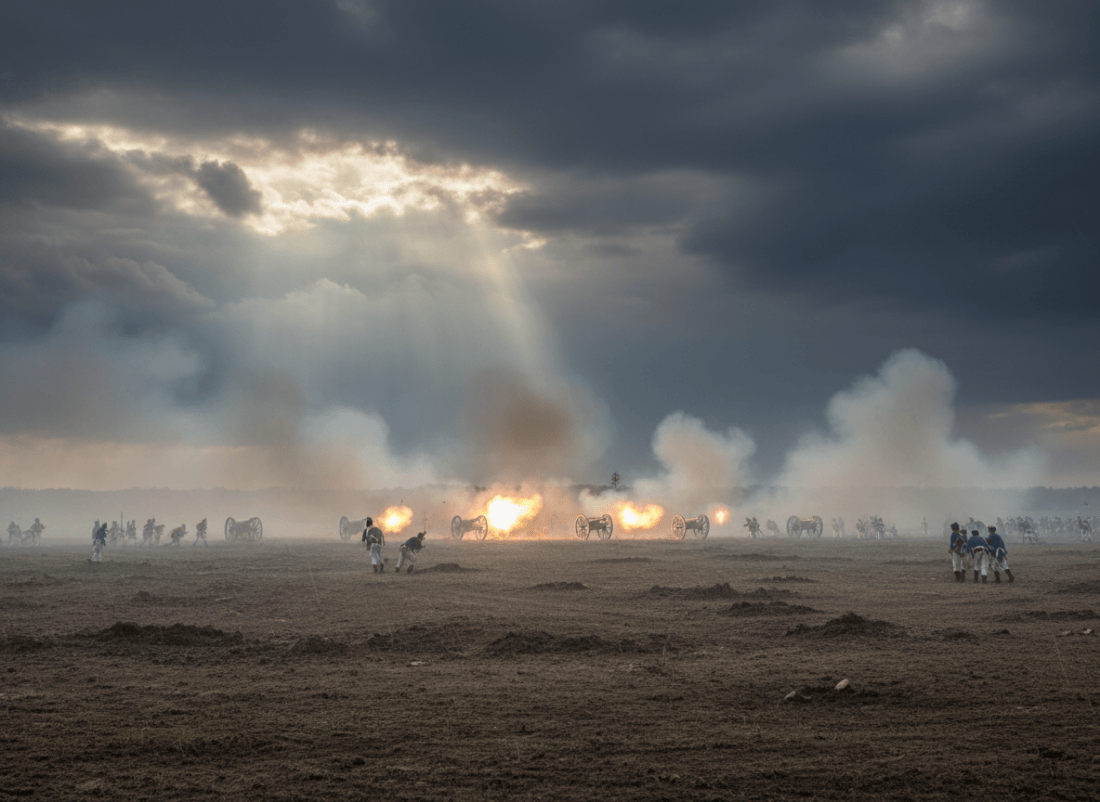
A dramatic cinematic historical battlefield scene showing artillery pieces firing in the distance, bright muzzle flashes, smoke and dust drifting across the landscape, dramatic stormy light, realistic but non-graphic, no visible injuries or corpses, wide composition suitable for a literary blog post.

However, despite our best efforts, some landed in fertile areas and they began to spread.

The fighting was brutal, no quarter given. Our artillery pounded their position. They consumed all living matter in their path, transforming into beasts that tried to assail our position.

All unfortified settlements were massacred.

The fighting went on for hours outside the major cities but all the preparation paid off. It should be noted that the Yami fought with distinction on behalf of the Empire. I hope that he grants them citizenship but if he decrees death, then so be it.

When it became clear that our forces would not be defeated, the Alachin ships left orbit abandoning their remaining forces. It still took many time cycles to fully eliminate what they left behind.

The environment of the planet suffered serious damage but should recover to its previously degraded states in little over fifty years.

From calculations of their trajectory, the Alachin ships have now left Imperial space.

May the Emperor have mercy on his humble servant.

The Battle of Yam 3

A dramatic, atmospheric scene of brilliant bursts of light streaming down from a vast night sky, radiant beams breaking through dark clouds, luminous gold, white, and pale blue energy illuminating the landscape below, cinematic science-fiction mood, highly detailed, no text or people

Production of anything not militarily valuable was halted. I decided to offer the remaining Yami their freedom if they fought. They chose to do so.

I consulted the archives to see if the Empire had any previous interaction with this threat. The only comparable species I came across was the Alachins, who destroyed a potential colony world. The description of what happened matches that of the Yami.

It was clear that we would be unable to win a space battle. Our battleships left years ago after our victory. So, we turned our efforts to suborbital guns. The gravity on the world was point eight times standard, so I was confident they would be effective.

The population of the planet, both human and Yami, banded together as brothers, working every minute they could. By the time the Alachins entered orbit, we were well prepared.

Our suborbital cannons took out two of their ships, but the rest released their cargo. It was like thousands of small comets landing all over the planet. But it wasn’t random. The Yami had an instinct that proved right about where they would land. They immediately came under fire.

Those that landed in radiation zones failed to multiply. The Yami had used nuclear weapons against the Empire and parts of the planet remained heavily contaminated.

To be continued..

The Battle of Yam 2

A cinematic science-fiction scene showing several approaching reptilian-type spaceships in deep space. The vessels are alien and organic-looking, with armored scales, angular predatory silhouettes, glowing eyes or slit-like lights, and subtle green-brown metallic textures. They advance toward the viewer through a vast starfield with distant nebulae, dramatic rim lighting, ominous atmosphere, highly detailed concept art, no text.

She told me of an intergalactic menace that lays waste to living worlds, reducing them to ash. The warning is embedded in their poetry and songs. It is a world on the outer rim of the galaxy, but I laughed when I first heard it. They were overdue, normally approaching that region of space every ten thousand years, and that the Yami would never have fallen to the Empire if they had not had to fight them.

There was something in her eyes. After all we had done, she still saw us as the lesser evil. It was something I hadn’t come across before.

I decided to be cautious. On the very outer rim of the Empire, there were no worlds close by to come to our aid. Spy ships were sent out into deep space to give warning of any approaching vessels. Plans for extra fortifications were put in place, as well as the creation of elite units.

Years passed, and nothing. Then, we lost communication with one, but not before a final message. A fleet of intergalactic ships of unknown design was heading in our direction. We didn’t have much time, only six months to make our final preparations.

To be continued..

The Battle of Yam (Alachins)

A dramatic, cinematic wide view of a fictional city after catastrophic destruction: severely damaged skyscrapers and collapsed buildings, smoke and dust drifting through empty streets, scattered debris, muted gray and amber light, atmospheric and somber, no people, no gore, no text, realistic concept-art style.

The following is the testimony of Supreme Commander Brigid Collentine about the defense of Yam in 82567 EY. to the Imperial Secret Service.

(From a historical perspective, this is the first instance of conflict between Alachins and the Empire)

I swear, on penalty of death, the following is a true account of what happened before, during, and after the battle of Yam.

In 8257 EY, I was assigned as Supreme Commander of the planet Yam. The Empire was still in the early of its occupation. The indigenous Yami population had been decimated and their resistance crushed. Their great cities and religious sites lay in ruins.

My first decision was whether or not they should be fully exterminated in the death camps. I decided that the remnants of the species would make good slaves instead. The blue creatures have great physical strength, an invaluable tool for human colonists.

The construction of new cities and military facilities then began in earnest. It was during the subsequent years that I learned about what I believe are now called Alachins from a Yami slave girl. I am aware that allegations have been made against me, but I swear she was only ever a sex slave.

To be continued

First Alachin Encounters P3

A dark, barren planet devoid of atmosphere or life, viewed from space. Charcoal-black rocky surface, stark craters and jagged terrain, no clouds, no haze, no vegetation, no lights, no signs of civilization. Deep black starfield, ominous cinematic science-fiction mood, realistic astronomical detail, dramatic side lighting, high contrast.

Time cycle 4

The Captain held the meeting very early in the time cycle. I was only half awake when it started. It was fairly rowdy and he had to ask for quiet on numerous occasions.

So we’re off to Cactus 351. It’s going to take another hundred years to get there. Not exactly paradise, it’s going to be on the warm side. We’re all going start our long sleep in a few hours, so this will be my last entry for quite some time.

On a positive note, we’re going in a different direction to those Alachins. We did our closest approach to the doomed planet an hour ago. Not even an atmosphere remains. We’re all still stunned.

First Alachin Encounters P2

A cinematic science-fiction illustration for a suspenseful blog story: viewed from deep space, a beautiful green-and-blue inhabited planet is being consumed and transformed by a strange alien spacecraft with an immense scaled, organic appearance. The planet darkens beneath the ship, with eerie shadowy energy spreading across its surface. In the foreground, the faint reflection of a terrified starship crew watching a holographic image, evoking dread, grief, and the collapse of their promised new home. Dark space, dramatic lighting, atmospheric, mysterious, serious literary sci-fi, no text, no logos.

Continued..

I look forward to the next time cycle with both trepidation and fear.

Time cycle 2

Something’s not quite right. They have stopped reawakening people. The crew are going around ashen faced, refusing to ask any questions, only to say that there will be a major announcement next time cycle. I saw the Captain about an hour, he was pale with bloodshot eyes.

Oh, what have I done? I should never have left.

Time cycle 3

Oh Emperor, it is worse than I thought. The Captain informed us that the planet has been stripped of all life. It can no longer sustain human habitation. There was nearly a riot. People couldn’t believe it, neither could I. Our promised land was gone.

The ship had a telescope fixed on the planet since we left. The Captain brought up a holographic image of what it shows. A strange looking alien ship with what looks like scales approaches the beautiful green and blue planet. Then the planet changes and becomes darker, before becoming difficult to decipher from the surrounding space.

People broke down in tears. Captain Peterson said the new species would be called Alachins after the planet Alachin that they had consumed in his report to the Empire.

He will inform us what the new plan is at the next time cycle. (To be continued)

Kraven the Hunter Review: Bloody, Pulp Fun With Wasted Potential

A cinematic editorial illustration for a film review of Kraven the Hunter: a rugged, intense hunter in a dark jungle at night, crouched among tangled vines and rain-slick foliage, with subtle urban-industrial prison architecture in the distant background. Moody Sony superhero thriller atmosphere, earthy greens and charcoal shadows, dramatic rim lighting, gritty realistic film-poster composition, no text, no logos, no gore.

I watched this film yesterday, and have quite mixed feelings about it.

Kraven the Hunter is the rare Sony Spider-Man spinoff that almost knows what kind of movie it wants to be, then keeps tripping over the same roots that sank Morbius and Madame Web. J.C. Chandor’s R-rated origin story, released in December 2024, is messy, frequently silly, and visually uneven. It is also bloodier, more committed to its pulp, and occasionally fun.

Aaron Taylor-Johnson plays Sergei Kravinoff, the estranged son of a Russian crime boss who becomes a vigilante hunter of evil men after a lion mauling and a dose of mystical blood give him animal strength, speed, and senses. The film opens with him already operating as an urban legend, then flashes back to a hunting trip in Tanzania with his father Nikolai (Russell Crowe) and softer half-brother Dmitri (Fred Hechinger).

From there it piles on Ariana DeBose’s Calypso, Alessandro Nivola’s Aleksei Sytsevich (the future Rhino), and Christopher Abbott’s Foreigner, before setting up Dmitri as the Chameleon. Screenwriters Richard Wenk, Art Marcum, and Matt Holloway treat the comic-book villain as a brooding antihero with a father complex, which is the right instinct and the wrong dosage.W

hat works is mostly physical. Taylor-Johnson sells the hunter fantasy with real commitment: barefoot climbs, knife work, and a prison sequence that at least has a pulse. The R rating is not decorative. People get mauled, stabbed, and thrown through environments in ways the PG-13 Sony spinoffs never allowed, and for a while that brutality gives the movie a meaner identity than “generic enhanced guy.” Crowe, chewing through a thick accent and a philosophy of dominance, is the most entertaining person on screen whenever he appears; he understands he is in a pulp gangster picture wearing a Marvel badge. Abbott’s Foreigner is similarly slippery and odd, the kind of supporting villain who briefly makes the film feel like it has a personality.

A London chase built around Dmitri’s kidnapping is the clearest evidence that Chandor, better known for Margin Call and All Is Lost, can stage momentum when the effects and geography cooperate.The problems start as soon as the movie has to explain itself. The mythology is a grab bag: lion blood, a family sanctuary, a lawyer who somehow becomes Kraven’s partner in a hit list, and a Rhino subplot that exists mostly so the third act can have a monster.

Accents wander. Calypso is underwritten to the point of comedy; DeBose is stranded with exposition and a personality that never arrives. The special effects, especially anything involving animal movement or Rhino’s transformation, often look unfinished, and critics were right to call out the spatial emptiness of the fights. T

he much-mocked climax, a short mud brawl in a field, is the movie admitting it has run out of ideas. Kraven’s moral position is also fuzzy in a way the script never resolves: he is introduced as the man who only hunts the wicked (but kills men who have done no more than trophy hunt at one point) , then spends the runtime proving he shares more of his father’s appetite than he will admit, without the film committing to either tragedy or satire. That last point is the real missed chance. Classic Kraven stories work because he is a predator with a code who eventually wants the one quarry who can beat him. This film never has Spider-Man, never really needs him for the plot it tells, and still feels shaped by the contractual absence.

The result is an origin that ends by gesturing at a larger universe (Chameleon, a harder Kraven) the box office made irrelevant. Compared with the rest of Sony’s spider-free web, it is less inert than Madame Web and less meme-dead than Morbius, which is faint praise and also true. Put your brain in park and the animal-man set pieces, Crowe’s ham, and the R-rated nastiness can carry an evening. Three stars out of five.