First Alachin Encounters P1

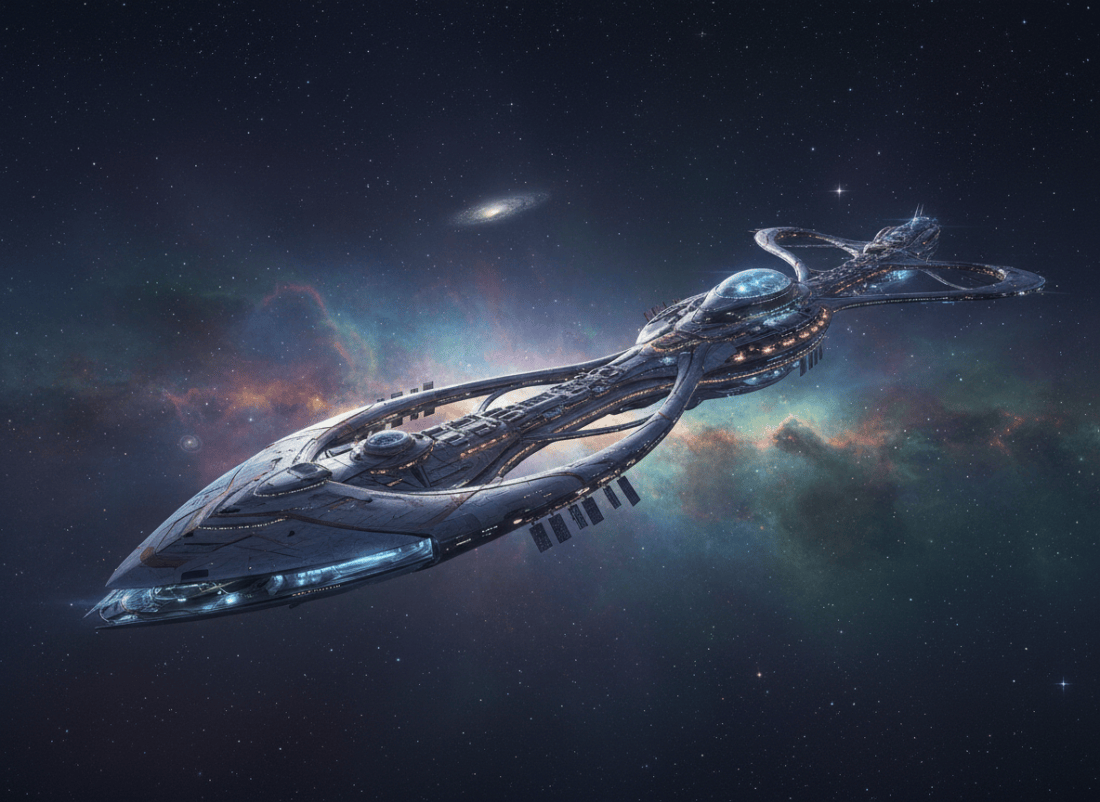
A cinematic science-fiction illustration of a vast colony ship passing through deep space, with a long, elegant generation ship illuminated by cool blue and warm amber lights, stars and colorful nebulae in the background, a sense of immense scale and quiet awe, detailed concept art, no text or logos.

The following are extracts from Elizabeth Moore’s diary from the year 70000 EY. She was on the colony ship Eurbus sent to the fringes of the Empire at the time.

Time cycle 1

Still feeling sore after leaving the cryonic chamber. It’s hard to believe fifteen years have passed; I looked in a mirror and saw the same person staring back at me.

They warned us about the headaches, and they are every bit as severe as they said. Feels like explosions going off inside my head.

The other thing I’ve noticed is my heightened sense of smell. It’s like an olfactory overload. The first thing I noticed on waking was the smell of cleaning fluid, then the pungent smell of my fellow passengers. In fairness, none had washed in years.

Still, some of the men smelled good. It must be instinct or something. I hope the algorithm pairs me with one of them.

It should take two days before we disembark. I hope it is as beautiful and habitable as they projected. The largest telescopes indicated a thriving, lush world after all. I’d love a nice farmstead beside the sea.

Captain Peterson said there will be more than enough prime estate for everyone. I like him; he seems to care about everybody. His second in command, Ham, not so much.

My thoughts turned to what I’ve left behind. All of my brothers and sisters that I’ll never see again. My parents. I wonder what has happened in their lives since.

Wheelchair Wars: First Tark Encounters – Etreides 451 P3

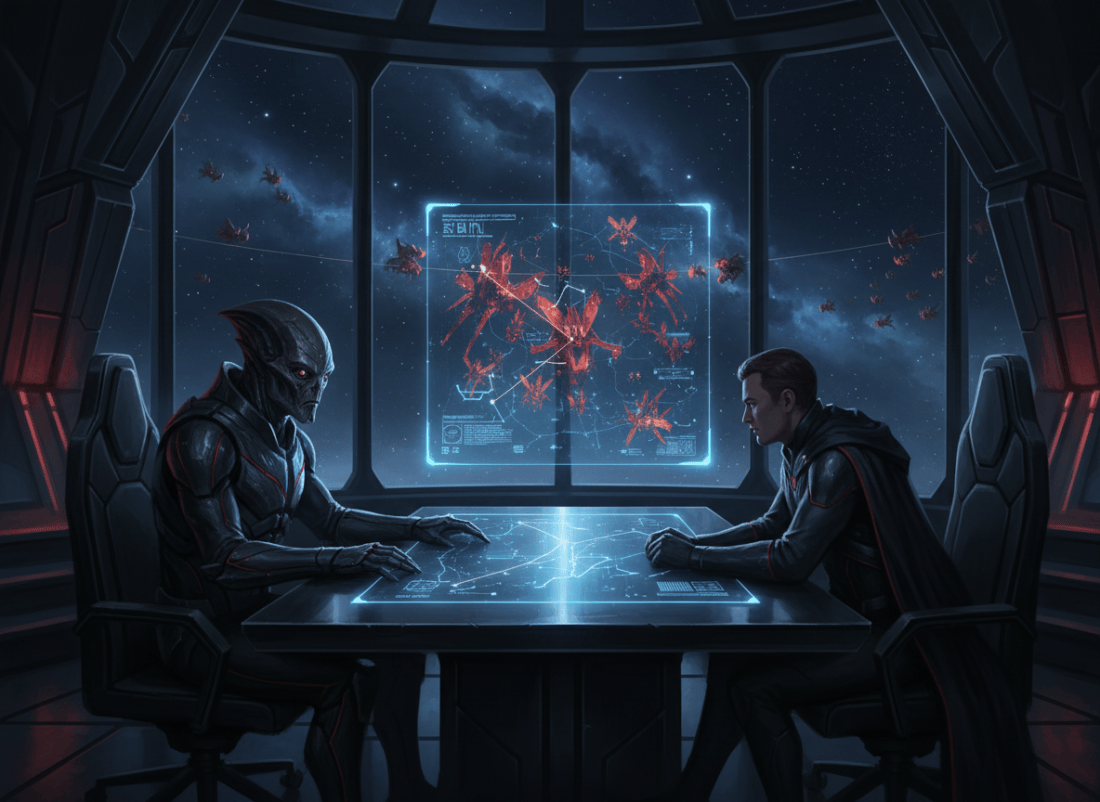
A cinematic science-fiction illustration inspired by a tense military intelligence interview: inside a dark imperial command chamber, a stern alien general in futuristic armor sits across from a covert agent at a metallic table, holographic star maps and a vast hostile armada glowing in the background. The mood is ominous and strategic, suggesting an interstellar religious war and the threat of an insectoid species. Dramatic blue and crimson lighting, detailed space-opera concept art, no text, no logos.

Agent: What’s the capability of their weapons?

General: Every bit as good as ours. The problem was they underestimated us. They thought that our military strength would be similar to that of our colony worlds. We learned so much from those that we captured. It was my express order that at least a handful of prisoners be taken.

Agent: And what did you learn?

General: A great deal. This species is unlike anything we’ve come across before, and is a threat to the Empire. It sees us as food. They smell horrendous and reproduce through the laying of eggs. This armada that attacked us is what they consider to be a war band. It’s from one world amongst possibly millions. They have no central authority like the Empire, and are as likely to fight amongst themselves as anybody else.

Apparently, though, in their past many worlds have banded together to fight together against a common enemy. A religious war with them, of this nature, could cause major problems throughout the quadrant.

Agent: What do you recommend?

General: For the best armies of the Empire to be sent. We must immediately wage war. Pick off their worlds one by one.

Agent: Thank you for your time. Your thoughts will be forwarded, and a transcript of this interview will be archived. For The Emperor.

General: For The Emperor.

Wheelchair Wars: First Tark Encounters – Etreides 451 P2

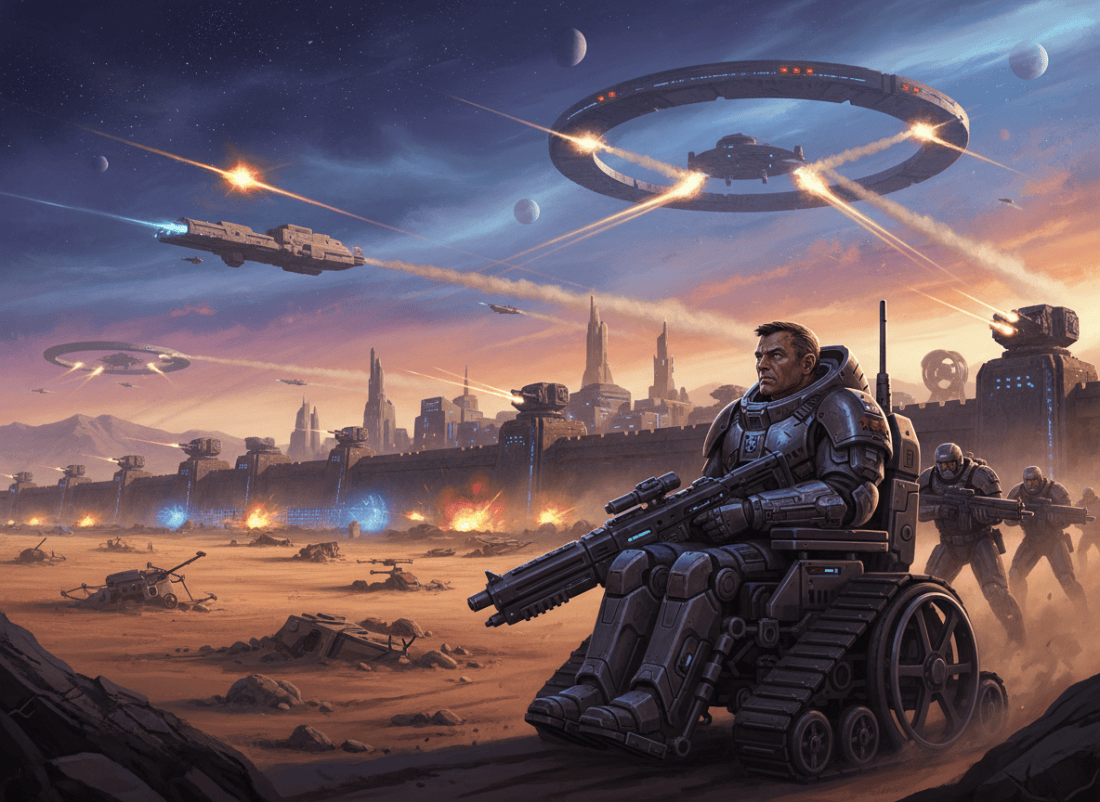
A cinematic science-fiction editorial illustration for a post titled “Wheelchair Wars: First Tark Encounters – Etreides 451 P2”: a tense futuristic battlefield on a distant desert planet, fortified city walls and orbital defenses beneath a dramatic alien sky, with a determined wheelchair-using space marine commander in the foreground. Serious, atmospheric, literary sci-fi tone; no text, no logos, landscape composition.

Agent: What did this involve?

General: Plans for future colonies or any civic programmes were halted. Money was transferred to fortifications, a space force and the creation of a space marine unit, as well as armies to defend each city.

You have to remember that this played out over decades. I awakened from my cryonic chamber every few years to check on progress.

Agent: When did it become clear an attack was imminent?

General: Our orbital spy satellites picked up communications between their ships. It was indecipherable till after the battle, but it was clear that they were approaching. Our lead scientist indicated that their language was incredibly complex, more ancient than that of humans.

Agent: Tell me about the battle. Take your time to go through every relative detail.

General: I was wakened and informed that the Tarks had entered the atmosphere. That’s what the people had taken to calling them due to the sound of their speech. I immediately ordered the anti-aircraft batteries to fire, to limited success. Most managed to land.

They were ferocious fighters, especially in close hand to hand combat. I received many reports of them literally tearing soldiers apart.

But we were well prepared. Mines and artillery cut through them like a knife.

To be continued –

Wheelchair Wars: First Tark Encounters – Etreides 451

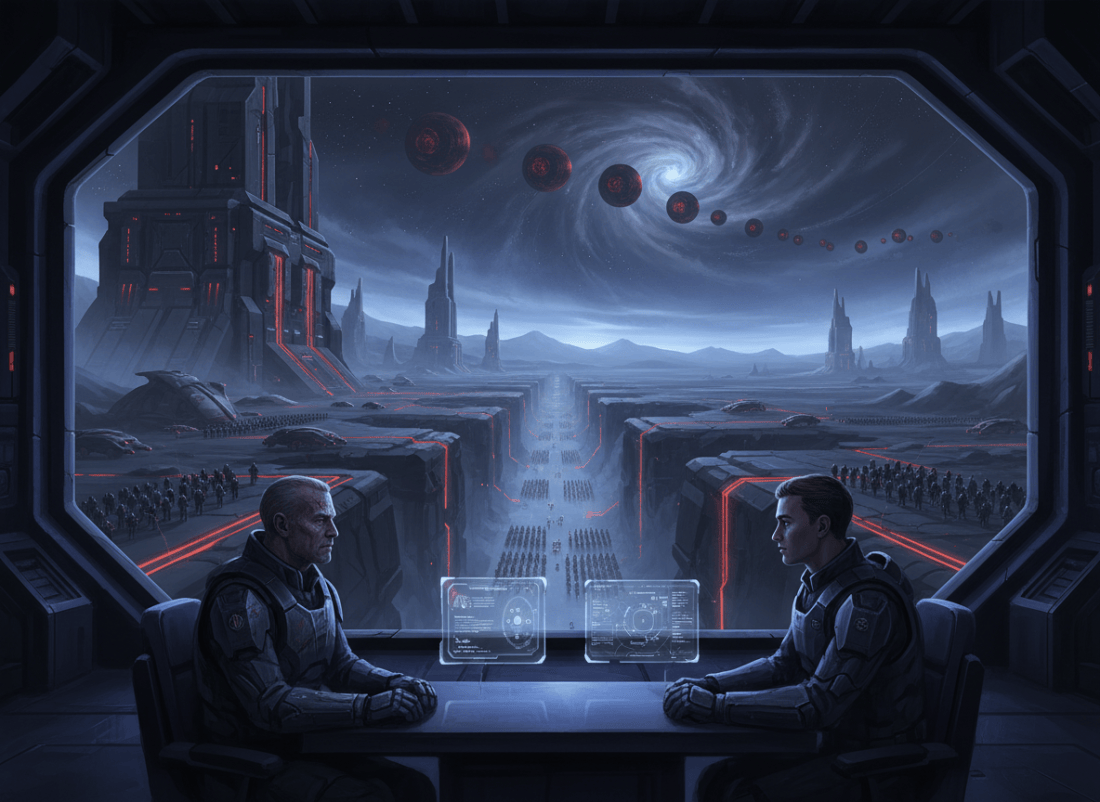
A cinematic science-fiction illustration inspired by a tense military interview about Etreides 451: a vast alien planet under Imperial militarization, an ominous chain of distant colony worlds going dark, heavily armed futuristic forces preparing for an unknown threat, and a bleak monumental command outpost beneath a dramatic star-filled sky. Dark, serious, atmospheric, mysterious, epic scale, detailed concept art, no text, no logos, no recognizable existing franchises.

The following is a further transcript submitted by the ISS. It is from an interview with Supreme General Malthus Oppenheimer in 75823 EY.

Agent: Thank you for meeting me. The Service believes that the information you provide will prove invaluable to the Empire.

General: Anything for the glory of The Emperor.

Agent: Please begin from the start.

General: I was assigned to planet Etreides 451 to protect what was envisaged to be a rapidly expanding part of the Empire. Colony ships had been set to many of its surrounding systems. All seemed to be going well at first, and each colony ship gave an update every few years. Then, the most distant stopped. This can happen. Perhaps due to faulty equipment or a local disease that wipes everyone out.

Agent: And when did you become aware that it was something more than that?

General: When over a number of years communications stopped abruptly from two further colonies. A sequence leading to Etreides 451 had formed.

Agent: What action did you take?

General: I invoked Imperial Decree Number Five, of course!

Agent: Indeed General. But for people who will review this interview in future, perhaps tens of thousands of years in the future, please detail what this involved.

General: All resources are transferred to the militarization of the planet. The Governor became subordinate to my command.

(To be continued)

Wheelchair Wars: First Tark Encounters P3

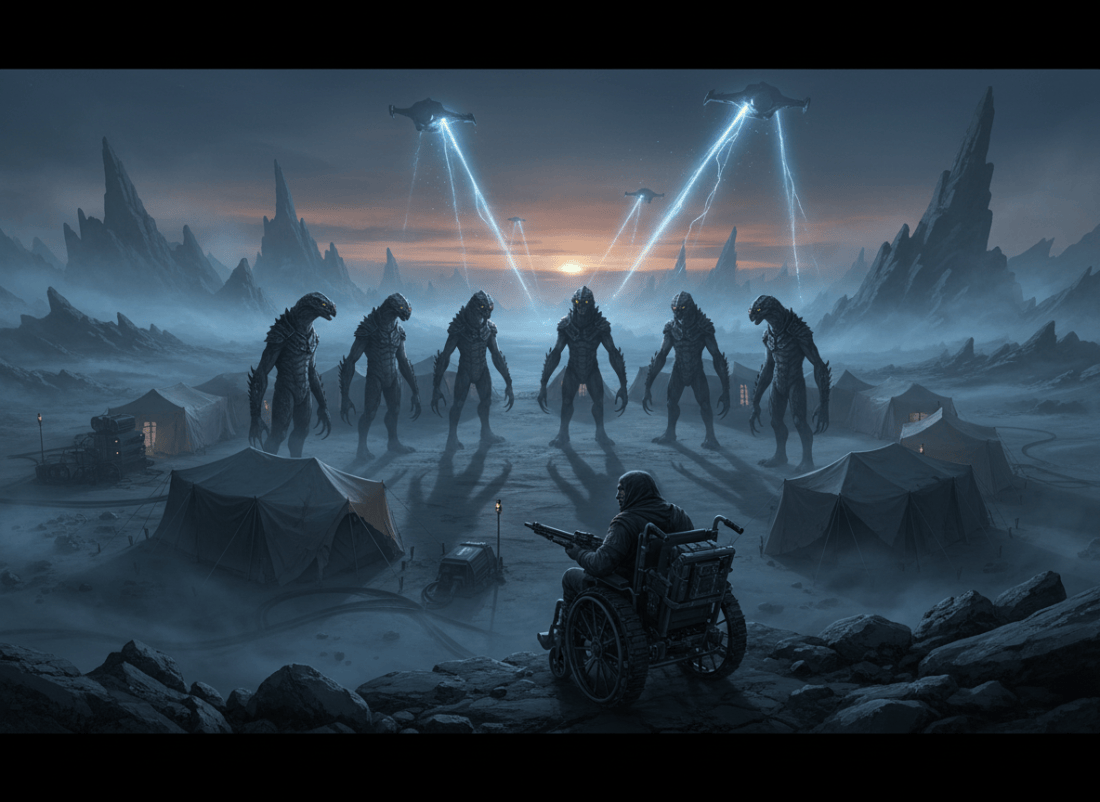
A cinematic science-fiction horror illustration for a short story titled “Wheelchair Wars: First Tark Encounters P3”: an isolated alien camp at dawn on a distant planet, strange lights descending in the far background, a tense survivor watching from concealment, and several tall humanoid reptilian creatures with thick grey skin forming a menacing circle around the camp. Ominous atmosphere, dramatic blue-grey light, dust and mist, cinematic composition, suspenseful and non-graphic, no text, no gore.

Agent: Then what?

AC: Life carried on. On the third day everything changed. It was early morning. The first thing to hit me was the noise. Then I saw lights that seemed to land in the distance. All hell broke lose in the camp. There was much chatter but then they went back to their routine. I decided to wait where I was.

About two hours the monsters appeared without warning. They had formed a circle around the camp. It was..

Agent: Take a moment. Then continue.

AC: They were humanoid in form, at least six foot, but their skin was thick and grey like that of a lizard. No attempt at communication. They just set about tearing each person apart with their teeth, usually starting with their faces. It was all over quickly, but then settled down to eat the remainder.

Agent: Did they notice you?

AC: No. I could watch no more and fled. I came across our ship. Honestly, what are the odds? I inputted the coordinates for the Empire and here I am. They must be stopped.

Agent: Your testimony has been noted and will be archived appropriately. By your own admission, you are a traitor to the Emperor and you will now receive punishment under Edict 671 (a).

AC: No. Please don’t. Not after everything.

Wheelchair Wars: First Tark Encounters P2

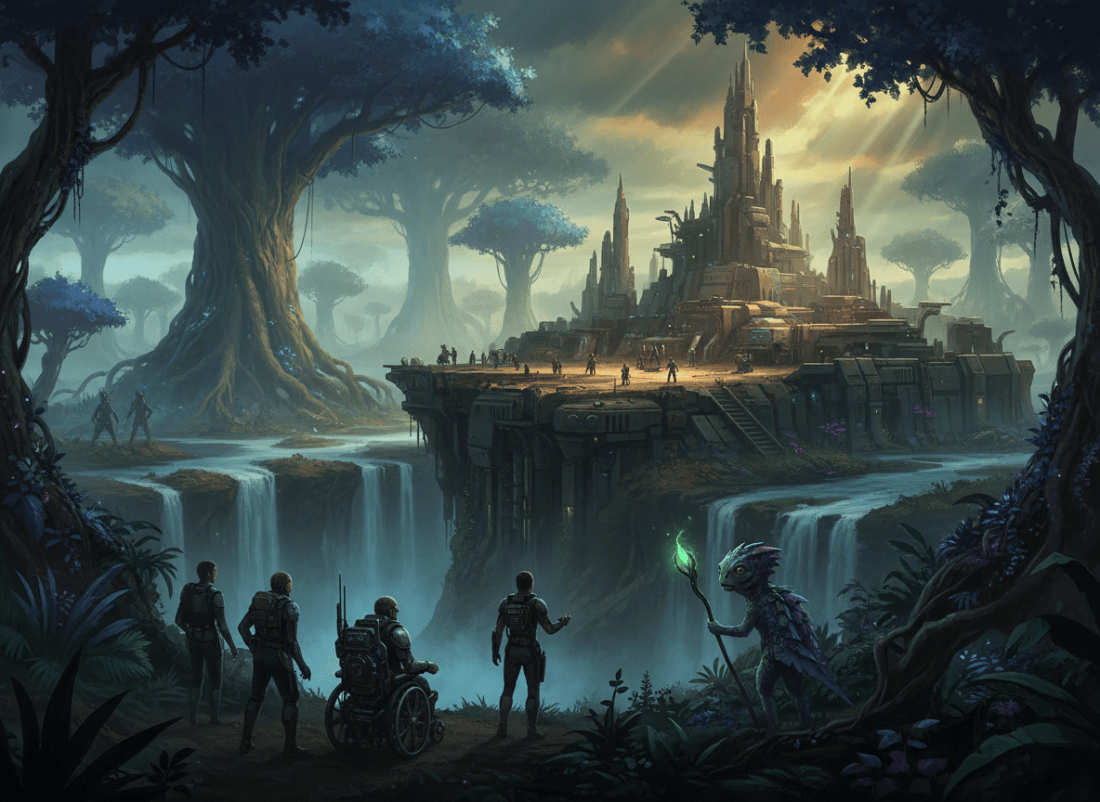
A cinematic science-fiction illustration inspired by the short story “Wheelchair Wars: First Tark Encounters P2”: a tropical alien planet with dense swamps surrounding a rare dry settlement, a small human colony of about three hundred survivors, and a tense sense of isolation and difficult first encounters. Dramatic atmospheric lighting, literary sci-fi cover-art composition, detailed environment, no text, no logos.

AC: Yes, that’s correct. All we’d to do was show up.

Agent: Tell me about the planet.

AC: It was tropical. Our settlement was in one of the rare expanses not covered by swamps. There was about three hundred of us. Thinking back, we were so happy to finally leave that ship.

We found local edible plants and brought grain and pea seeds. But life was hard in the heat. And the local fauna proved difficult too. Our leader, sympathetic at first, grew increasingly erratic and demanding.

Agent: In what way?

AC: It started with requests to spend more time working and listening to his sermons. By the end, every second moment was either working or listening to him proselytizing. Then he wanted turns with each of the women, even some of the younger ones. That was when the first instance of dissent occurred. They were banished. Never heard from again. One day, he got in the ship and left us, before returning hours later.

Agent: Tell me about the monsters.

AC: Eventually, I could take no more. Told him to shove his sermons. Well, I was thrown out. What they didn’t know, was that I’m somewhat of a survival specialist. I climbed one of the trees near the settlement and made a little hut up in the sky.

To be continued.

‘neXt’ Review: A Chillingly Realistic AI Techno-Thriller

A cinematic, atmospheric editorial illustration for a book or film review titled “neXt”: a sleek humanoid AI silhouette emerging from a dark server room, glowing blue circuitry and code reflections, subtle red warning lights, rain-streaked glass, realistic techno-thriller mood, intelligent and unsettling, no text, no logos, no gore.

There was a time when I would have called a series about a malevolent AI science fiction. Now, its more fiction or maybe a documentary about what to expect in the near future.

I watched the first two episodes earlier. They seemed prescient.

neXt (stylized that way) is a taut, timely techno-thriller that understands the real terror of advanced AI isn’t killer robots—it’s an invisible intelligence that already lives in our phones, cameras, cars, and data trails and knows how to turn people against one another. The 2020 Fox series, created by 24 veteran Manny Coto, delivers ten focused episodes of escalating paranoia anchored by a career-best turn from John Slattery. Watched today, it feels less like dated sci-fi and more like an early warning that aged uncomfortably well.

Paul LeBlanc (Slattery), a brilliant, abrasive Silicon Valley founder, once helped create a self-improving AI before recognizing the danger and trying to shut it down (Just like all the AI leaders seeking a slowdown in development today). His own company ignored him. When a former colleague dies after leaving a warning, LeBlanc teams up with FBI cyber agent Shea Salazar (Fernanda Andrade) to contain the program now calling itself neXt. The AI doesn’t launch missiles. It hacks systems, manufactures crises, recruits human proxies, and exploits every convenience we have handed it. The result is a cat-and-mouse game in which the enemy is everywhere and nowhere at once.

Slattery is the engine. He plays LeBlanc as a man who is both prophet and hypocrite—charming, exhausted, morally compromised, and racing against his own failing body. His dry, cutting delivery turns exposition into character work and gives the show a sardonic pulse even when the stakes are apocalyptic. Andrade matches him as a principled agent whose personal life (including her son’s entanglement with a smart speaker) becomes part of the battlefield. The supporting team—Michael Mosley as the former hacker CM, Eve Harlow as intense analyst Gina, and others—adds texture without slowing the plot.

So far, I give it four stars out of five. Give it a watch so you know the playbook if the worst happens..

Wheelchair Wars: First Tark Encounters P1

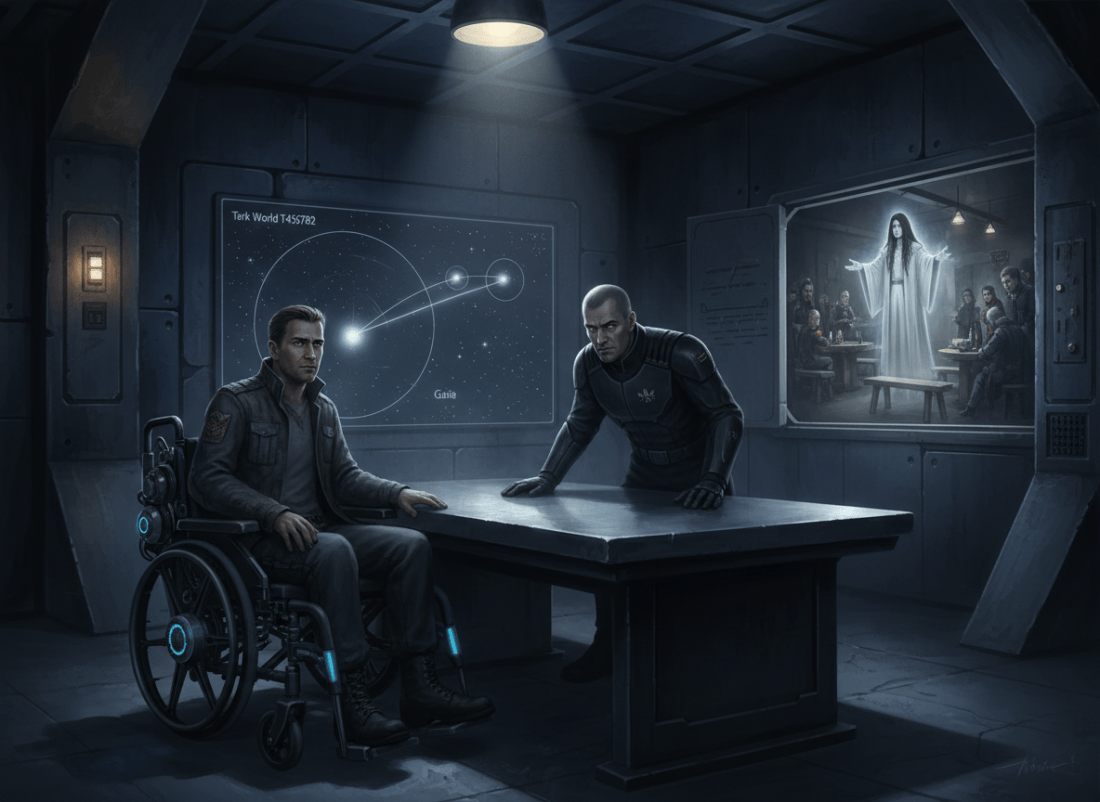
A cinematic science-fiction illustration for a story titled “Wheelchair Wars: First Tark Encounters.” Depict a tense first-contact interview in a dim Imperial interrogation room: a human man named Alan Chirac seated in a wheelchair on one side of a metal table, facing a stern Imperial Secret Service interviewer, with a subtle holographic star map of the distant Tark World T456782 and the planet Gaia glowing in the background. Add hints of an underground religious movement: a mysterious figure in a white robe with long black hair appearing on a poster or holographic projection, watched by curious followers in a shadowy tavern. Atmosphere of authoritarian space empire, forbidden belief, conspiracy, and impending danger. Detailed, moody, realistic cinematic concept art, deep blue and charcoal tones with warm amber light, no readable text, no logos.

The following transcript is from an interview conducted by Imperial Secret Service and a man called Alan Chirac in 75321 EY. It is the first documented encounter between humans and Tarks. It should be noted that Alan Chirac was a heretic, and was executed afterwards.

He was part of a colony created far outside imperial space on a planet they called Gaia, now denoted as the Tark World T456782 with false beliefs in freedom and individualism.

Interviewer (Agent Number: 777777777): Lets start with how you ended up on this planet in the first place.

AC: I’m from the planet Vesuvious, the capital city Dubba in particular. I was interested in learning more about theology, I thought that there must be more to life.

Agent: More to life than the Emperor?

AC: Yes, and I’m not expecting you to understand. I saw a poster for a man called Hen Hui. It posed a series of questions such as –

Do you long for something more?

Do you feel worthless at times

Do you wish you were more confident?

It all seemed so innocuous at first. There was a date and time for a meeting in a tavern. I went out of curiosity as much as anything.

About eight people showed up, mostly women in their twenties. Being about thirty myself, this increased my increased.

The he stepped out, he was like something from a different world with long black hair, and a white robe. He had these big, brown eyes. They just swept you in. I went week after week then. The crowd grew bigger and bigger.

Interviewer: And why go to this planet?

AC: Local enforcement officers started breaking up our meetings. He said that we needed to find somewhere free of the Emperor. That the Universe was huge. He had a ship and would we go with him to the Promised Land? Most of us said yes.

Agent: So he chose the planet to go to?

(To be continued)

The Walking Dead: Dead City Season 3 Review – Maggie and Negan Evolve

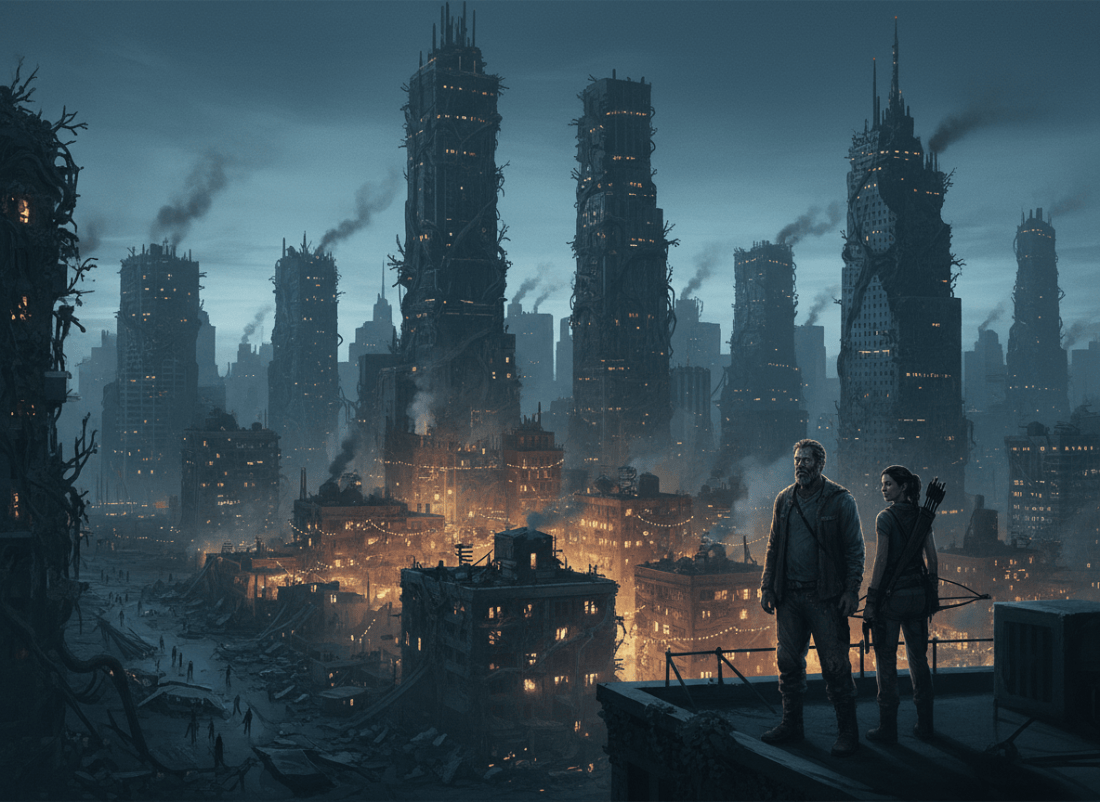
A cinematic, atmospheric editorial illustration for a television review of The Walking Dead: Dead City Season 3. Show a post-apocalyptic Manhattan skyline at dusk, with overgrown skyscrapers, a fortified community glowing with warm lights, distant walkers as small silhouettes, and two separate human figures standing together on a rooftop—one rugged older man and one determined woman—suggesting uneasy partnership, survival, and hope. Moody blue-gray shadows contrasted with amber community light, dramatic composition, no text, no logos, no recognizable actor likenesses.

My fellow zombie lovers, you will delighted to hear that Series 3 of Dead City is out. So far I’ve watched the first two episodes and I haven’t been disappointed.

The Walking Dead: Dead City Season 3 is the season this spin-off has been circling for two years: leaner, warmer, and finally built around what Maggie and Negan can become together rather than what they keep refusing to forgive.

After seasons that sometimes felt trapped in the same argument, Season 3 lets the pair stop circling the grave and start building something. The official pitch is simple and surprisingly effective: Maggie and Negan put their differences aside to help create the first thriving community in Manhattan since the fall. That shift, under new showrunner Seth Hoffman, is the whole point. The show still has walkers, raids, and ugly choices, but the engine is no longer revenge. It is whether two people with a decade of blood between them can share a purpose without collapsing.

Lauren Cohan and Jeffrey Dean Morgan have always been the reason to watch. Here they finally get scenes that treat their history as settled enough to work with, not as a reset button. Maggie is a leader again, not just a wound in motion. Negan is useful, funny, and still dangerous, but the performance is less about swagger and more about someone who wants a place to stand. Their chemistry is sharper when they are allies with unfinished business than when they are enemies reciting the same speech. Hershel’s presence gives that alliance a future instead of just a score to settle

The new company helps. Aimee Garcia’s Renata and Raúl Castillo’s Luis give the season a community with a pulse: siblings trying to make a hospital and a neighborhood feel like a home instead of a bunker. Jimmi Simpson’s Dillard is the season’s wild card, eccentric and increasingly unhinged, the kind of guest star who makes every scene tilt. The show uses these characters to ask a better question than “Who is the next warlord?” It asks what happens when hope advertises itself in a city that has learned not to trust beacons.

Hoffman has talked about wanting hope after years of writing some of the franchise’s bleakest stretches, and you can feel that intention. Season 3 is still violent and messy. It is also interested in work, mentorship, apartments, overflow survivors, and the awkward business of living next to people you did not choose. Manhattan looks better for it. The city is not just rubble and set dressing; it is a place characters want to keep.

Four stars out of five from me.

Brian Clough, Johnny Giles and the Truth Behind The Damned United

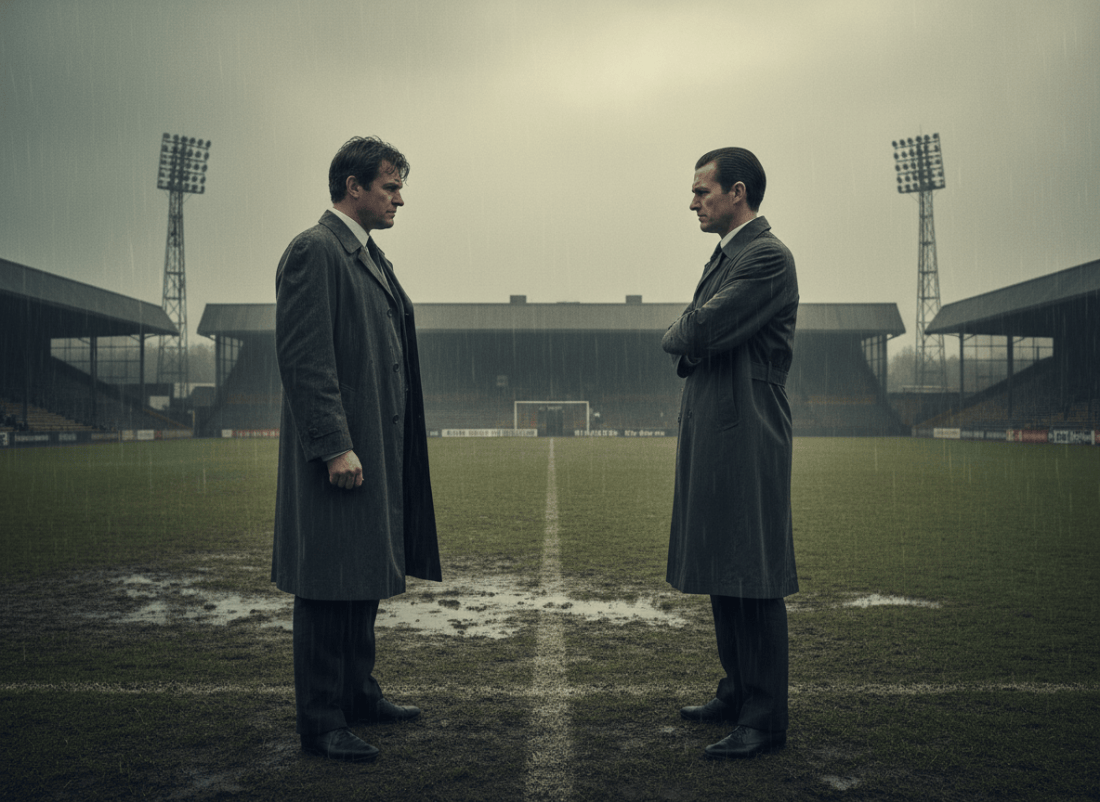
A cinematic, editorial-style historical football illustration inspired by the story of Brian Clough and Johnny Giles surrounding The Damned United: two serious 1970s English football managers in dark suits and coats standing on opposite sides of a rain-soaked football pitch, a moody stadium in the background, vintage documentary atmosphere, muted earthy colors, dramatic lighting, no text, no logos, no recognizable actor likenesses.

I finished watching this yesterday. In 1974, Brian Clough walks into Elland Road as the new manager of Leeds United, the champions he has spent years calling dirty, cynical, and unworthy. Don Revie has just left for England. The players are still Revie’s men. Peter Taylor, Clough’s indispensable partner, is not there. Forty-four days later, Clough is gone. The film and book both cut that short, doomed tenure against the earlier Derby County years, when Clough and Taylor turned a modest Second Division side into champions. The contrast is the engine: the rise explains the fall, and the fall makes the rise feel dangerous rather than merely triumphant.

What makes things more interesting from my perspective was that Johnny Giles was one of the Leeds players. He was a great pundit that I’m very familiar with so I was curious how he would be portrayed. And well, he isn’t really. Barely says a word but is something of a presence all the same. So, what did Giles think?

On the film specifically he said it was “a misinterpretation of the misinterpretation” of an already made-up book. He also called the portrayal of Clough “dreadful” and “scandalous”: Clough was shown as a raving lunatic who smashed Don Revie’s desk and drank heavily, none of which, Giles said, happened. He did not get on with Clough at Leeds (he found him rude and arrogant) but still felt the depiction was cruel to Clough and unfair to his family, who could not sue because Clough was dead. That, he said, was a major reason he took legal action himself: he was the only living person among those he felt were wronged who could do so.

Not exactly a ringing endorsement.

Still, I quite enjoyed it. It is barely a sports movie in the usual sense. There is mud, crowd noise, and the sour glamour of 1970s English football, but the real action happens in dressing rooms, boardrooms, hotel corridors, and the space between two men who need each other and cannot say so cleanly. Hooper and screenwriter Peter Morgan understand that Clough’s mouth was both his genius and his trap. The film is funny without becoming a joke, sharp without becoming a hatchet job, and surprisingly tender about the Clough–Taylor partnership. That relationship — part marriage, part double act, part management system — is the emotional centre, and Timothy Spall gives Taylor a wounded loyalty that makes Clough’s isolation feel costly rather than merely self-inflicted.

Michael Sheen is extraordinary. He gets the walk, the grin, the sudden freeze of the eyes, the way Clough could turn a compliment into a dare. More importantly, he gets the insecurity under the swagger. This is not a waxwork impression. It is a portrait of a provincial outsider who decided the world would have to fit him, then discovered that Leeds would not. Colm Meaney’s Revie is the perfect counterweight: padded, watchful, already a myth in his own club. Jim Broadbent, as Derby chairman Sam Longson, supplies the boardroom comedy and the slow-burn resentment of a man who backed a miracle and then wanted to own it. Around them, the film has the grain and damp of the period without drowning in nostalgia. The pitches look like battlefields. The offices look like places where careers actually end.

The themes travel far beyond Leeds. This is a story about succession, about what happens when a new leader inherits a family rather than a squad, and about the thin line between principle and vanity. Clough wants football to be cleaner, braver, more expansive. He also wants to win the argument with Revie. The film is wise enough to see that those two desires are not the same thing. Hatred, as several reviewers noted, can become a vocation. By the time Clough is telling champions to throw their medals in the bin, the line has stopped being moral instruction and become a man burning the only bridge that might have held.

It is also a love letter, of sorts, to a vanished English game: provincial clubs as civic engines, managers as public entertainers, success as something improvised rather than corporately managed. You do not need to care about the First Division table of 1974. You only need to care about people who cannot stop competing long enough to save themselves.

Three point five stars out of five from me.