The Boroughs Review: Aging with Monsters and Heart

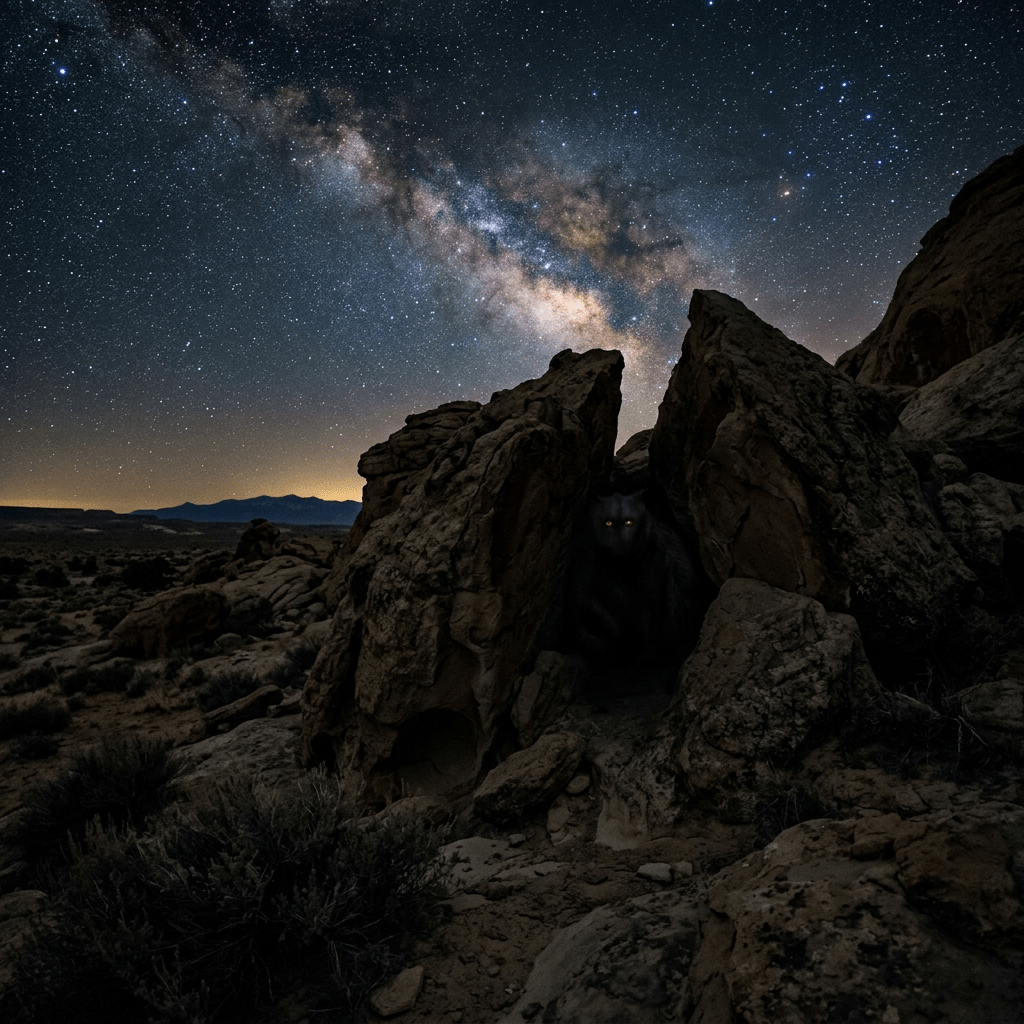
Rocky desert landscape at night with glowing eyes in shadows beneath starry sky

For those that have been missing Stranger Things, I have great news, the Duffy Brothers are back, at least as executive producers.

The Boroughs is an American science fiction television series created by Jeffrey Addiss and Will Matthews. It premiered on Netflix on May 21, 2026.

Set in the sun-drenched New Mexico desert, The Boroughs follows a picturesque retirement community that promises its residents the “time of their lives.” On the surface, it’s idyllic: golf carts, barbecues, lifelong friendships, and a sense of purpose in the golden years. But beneath that lies a sinister, otherworldly threat that’s literally stealing the one thing these retirees don’t have in abundance—time itself.

What starts as a seemingly light supernatural mystery evolves into a high-stakes battle for survival, blending creature-feature horror, clever sci-fi twists, and genuine human drama. The show excels at balancing Spielbergian wonder and scares with deep empathy for its characters’ experiences of aging, loss, friendship, and rediscovering purpose later in life. It’s never preachy or maudlin—it’s fun, propulsive, and often hilarious.

The all-star ensemble is the heart of the show. Alfred Molina shines as Sam Cooper, a grieving widowed engineer who’s reluctantly moved in after losing his wife. His journey from cynical outsider to determined hero is beautifully layered—funny, vulnerable, and heroic without ever feeling forced.

Geena Davis giving a stand out performance brings charisma and fire as Renee, while Alfre Woodard delivers gravitas and sharp wit as Judy. The supporting cast is equally fantastic: Denis O’Hare (a standout for his hilarious yet poignant Wally), Clarke Peters, Bill Pullman, and more round out a group of misfit retirees who feel like real people you’d want to hang out with. Their chemistry crackles in every barbecue scene, late-night conversation, or improvised plan against the threat. These aren’t caricatured “cute old folks”—they’re complex, flawed, vibrant humans with rich backstories, romantic entanglements, and plenty of edge.

The first episodes hook you with mystery and charm, then ramp up the tension and spectacle perfectly across the season. The creature design and effects are impressive—eerie, inventive, and integrated seamlessly into the story.

If you’re craving smart sci-fi with monsters, mystery, and massive heart, or just a story that makes you laugh, gasp, and root hard for its characters, The Boroughs is must-watch television. It reminds us that even in life’s later chapters, the best stories—and the biggest fights—can still be ahead.

Five stars out of five from me. Make sure to give it a watch.
Obi-Wan Kenobi Season 1 Review: A Star Wars Gem

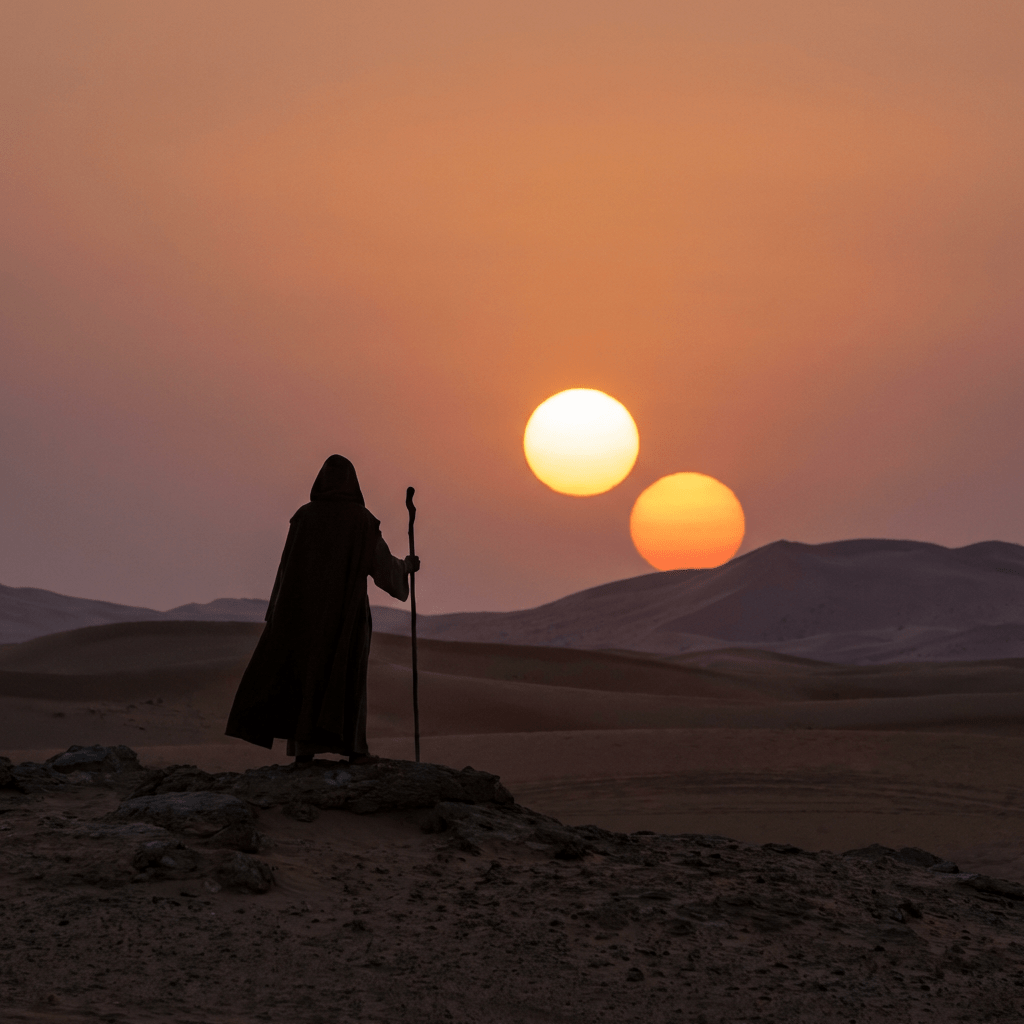
Silhouette of a cloaked figure with a staff watching a binary sunset in a desert.

Hi everyone! Yes, I’ve been back watching Disney+ in a Star Wars frenzy. This time, I’ve been catching up with Obi-Wan in this heart-warming Season 1.

Obi-Wan Kenobi Season 1 (2022) is an emotionally resonant return to the Star Wars galaxy that successfully bridges the gap between Revenge of the Sith and A New Hope. This six-episode limited series elivers a character-driven story focused on healing, redemption, and quiet heroism, all anchored by Ewan McGregor’s masterful reprise of the iconic Jedi Master. While it doesn’t aim for the bombastic scale of some big-screen entries, it excels as an intimate, soulful exploration of trauma, purpose, and the enduring light of the Force. Set ten years after the fall of the Republic and the rise of the Empire, the series follows Obi-Wan Kenobi—now living in exile as “Ben” on Tatooine—as a broken man haunted by guilt over Anakin Skywalker’s transformation into Darth Vader. He has shut himself off from the Force, working a mundane job while secretly watching over young Luke Skywalker from afar.

Inquisitors who work on behalf of the Empire hunt Jedi or even people with limited abilities in the Force, adding an extra threat.

Ewan McGregor stars as the title character, reprising his role from the Star Wars prequel trilogy. Co-stars such as Joel Edgerton, Bonnie Piesse, Jimmy Smits, Hayden Christensen (Vader), and Ian McDiarmid also reprise their prequel trilogy roles. At the same time, Vivien Lyra Blair debuts as a young Leia Organa. The project originated as a spin-off film written by Hossein Amini and directed by Stephen Daldry, but it was reworked as a limited series following the commercial failure of the film Solo: A Star Wars Story (2018).

After remaining in hiding for the next ten years on the planet Tatooine, watching over Anakin’s son Luke, Kenobi is called on a mission to rescue Anakin’s daughter Leia when she is kidnapped by the Galactic Empire’s Jedi-hunting Inquisitors in a plot to draw Kenobi out.

At the core of the series’ success is Ewan McGregor’s phenomenal performance. He slips effortlessly back into the role, bringing layers of weariness, regret, dry humor, and quiet strength that make Obi-Wan feel profoundly human. Watching him evolve from a defeated hermit to a Jedi reigniting his connection to the Force is deeply satisfying and emotionally rewarding.

The supporting cast shines as well. Moses Ingram brings intensity and complexity to Reva (the Third Sister), a relentless Inquisitor whose backstory adds depth and tragedy to the Empire’s hunt for Jedi. Hayden Christensen’s return as Darth Vader is chilling and powerful—his limited but impactful appearances, especially in the later episodes, deliver some of the most memorable confrontations in the saga. The Inquisitors and other Imperial figures create a palpable sense of danger, while cameos and references to prequel and original trilogy lore reward longtime fans without feeling forced.

Visually, Obi-Wan Kenobi is a treat. The production design beautifully blends the sandy desolation of Tatooine with the sterile oppression of Imperial worlds and the vibrant, lived-in feel of Alderaan. Practical effects, impressive lightsaber duels, and John Williams-inspired scoring (with new themes by Natalie Holt) elevate key moments, particularly the thrilling finale that features some truly epic, emotional lightsaber action worthy of the franchise’s legacy.

Four stars out of five from me. May the Force be strong in you.

Star Trek: Starfleet Academy Review – A New Era of Cadets

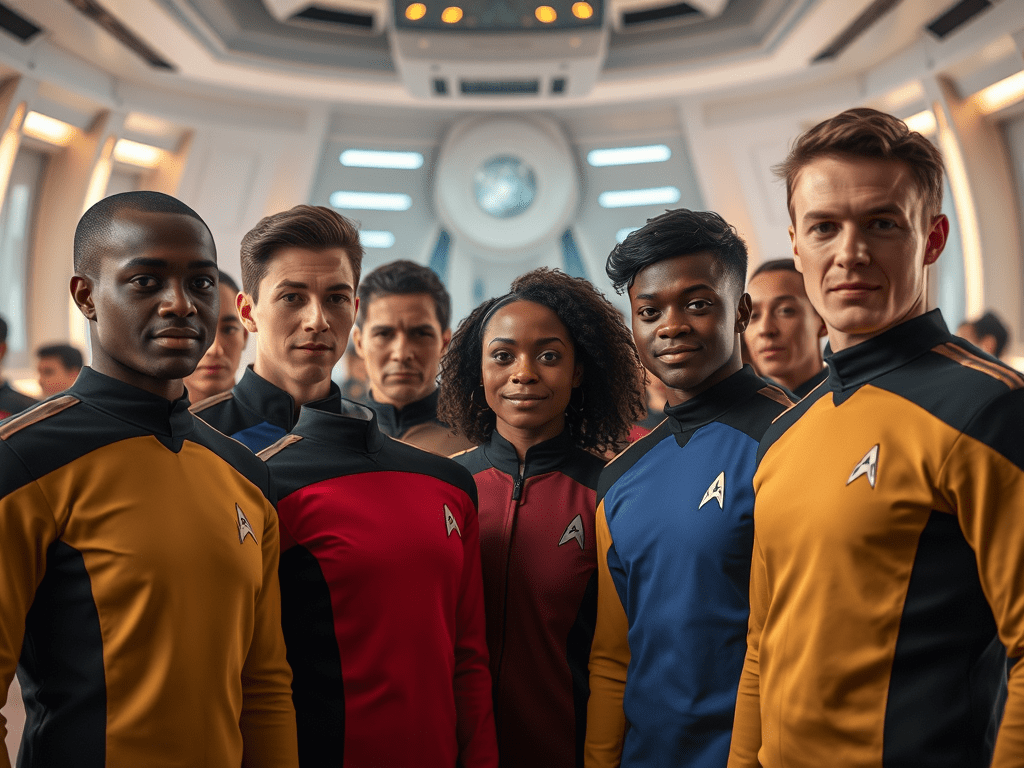
My dear readers, a new Star Trek series is here! Star Trek: Starfleet Academy is the 12th Star Trek series and part of executive producer Alex Kurtzman’s expanded Star Trek Universe. Set in the 32nd century, the far-future time period that was introduced in the later seasons of the series Star Trek: Discovery (2017–2024), Starfleet Academy follows the first new class of Starfleet cadets in over a century as they come of age and train to be officers. This is the period after “The Burn” that almost totally destroyed the Federation

Sandro Rosta, Karim Diané, Kerrice Brooks, George Hawkins, and Bella Shepard portray Starfleet Academy cadets, starring alongside Holly Hunter and Zoë Steiner, as well as Tig Notaro and Oded Fehr, who are reprising their roles from Discovery, and Robert Picardo returning as the character of the Doctor from other previous series.

So far, I’ve only watched the first episode, and I think it will gain traction. From a kind, non-violent Klingon to the first holographic cadet, it could get very interesting. The ensemble cast is introduced with care, giving each character a clear emotional hook without overwhelming the audience. Their interactions feel lived-in and sincere, suggesting long arcs of growth rather than quick archetypes. Importantly, the episode allows vulnerability to coexist with ambition; these cadets are capable and driven, but also uncertain, impulsive, and still figuring out who they want to be. That balance makes their journey immediately compelling.

One of the episode’s greatest strengths is its focus on perspective. By centering the story on cadets at the very beginning of their Starfleet journey, the show reclaims a sense of awe that longtime fans may remember from earlier Trek, while also making that wonder feel fresh. The Academy isn’t just a school—it’s presented as a crucible where personal histories, cultural differences, and ethical ideals collide. The premiere smartly uses this setting to explore what Starfleet represents in a changing galaxy, and why those values still matter.

On a more negative note, I feel the show could do with some eye candy. Most are plain, there is no seven of nine vibes, which I think is a pity.

Overall, the premiere succeeds because it’s hopeful. In a television landscape often dominated by cynicism, Star Trek: Starfleet Academy leans into the idea that learning, empathy, and shared ideals can genuinely shape a better future.

So far, I give the show three stars out of five. I’m looking forward to watching more.

Any other Trekkies out there? Leave a comment.

And don’t forget to subscribe.

Why Dune is a Must-Read for Sci-Fi Fans

I finally did it, I read the novel Dune, written by Frank Herbert and originally published way back in 1965. It’s a significant feat, at one hundred and eighty thousand words. And every page was worth it! It’s one of the best-selling science fiction novels of all time.

Dune is set in the distant future in a feudal interstellar society, descended from terrestrial humans, in which various noble houses control planetary fiefs. It tells the story of young Paul Atreides, whose family reluctantly accepts the stewardship of the planet Arrakis. While the planet is an inhospitable and sparsely populated desert wasteland, it is the only source of melange or “spice”, an enormously valuable drug that extends life and enhances mental abilities. Melange is also necessary for space navigation, which requires a kind of multidimensional awareness and foresight that only the drug provides. As melange can only be produced on Arrakis, control of the planet is a coveted and dangerous undertaking.

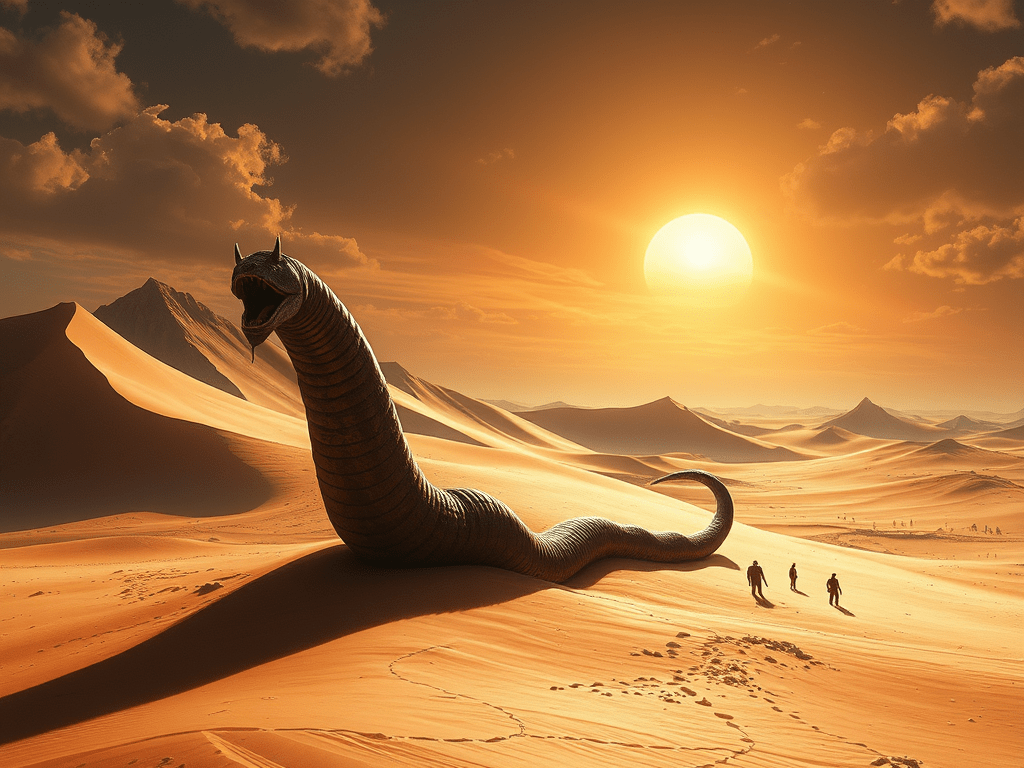
This is one of those rare novels that feels vast without ever losing its grip on the reader. From the opening pages, Herbert immerses us in the harsh deserts of Arrakis, a world where sandworms rule, water is sacred, and politics are as deadly as the climate. The setting is not just a backdrop but a living system, intricately tied to culture, religion, economics, and power. Few science fiction novels build a universe that feels this coherent, purposeful, and alive.

The level of detail does mean it can be a hard slog at times, but I became increasingly engrossed. As a writer of science fiction myself, reading the novel spoke to me about the immense importance of world-building and that even minute details are important.

The political intrigue is equally gripping. The power struggle between House Atreides, House Harkonnen, and the Emperor unfolds with the complexity of a grand historical drama. Herbert trusts his readers, refusing to over-explain, and instead allows meaning to emerge through dialogue, internal monologue, and carefully placed details. This approach rewards close reading and makes the world feel ancient and layered, as if the events of the novel are just one chapter in a much larger history.

Herbert’s treatment of ecology was remarkably ahead of its time. Arrakis is a planet shaped by scarcity, and the Fremen’s intimate understanding of their environment is portrayed with deep respect. The idea that an ecosystem can be deliberately transformed—and that such transformation carries cultural and moral costs—feels strikingly modern. The sandworms, the spice melange, and the planet’s fragile balance form one of the most memorable and meaningful ecological systems in all of science fiction.

Ultimately, Dune endures because it combines epic storytelling with serious ideas, without sacrificing tension or wonder. It is a novel that challenges the reader as much as it entertains, offering action, mysticism, and political drama while quietly probing the dangers of power and prophecy. More than sixty years after its publication, Dune remains not just a cornerstone of science fiction, but a profound and unsettling meditation on the future of humanity itself.

Five stars out of five from me.
Star Wars: The Rise of Skywalker Review

Well, I finally got around to seeing this. This lapse would be very difficult to explain to my ten-year-old self. But was it worth the wait?

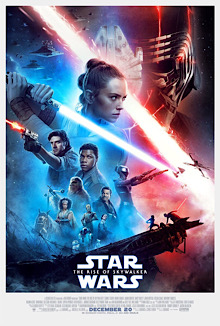
Star Wars: The Rise of Skywalker (also known as Star Wars: Episode IX – The Rise of Skywalker) is a 2019 American epic space opera film produced, co-written, and directed by J. J. Abrams. Produced by Lucasfilm and Bad Robot, and distributed by Walt Disney Studios Motion Pictures, it is the third installment of the Star Wars sequel trilogy, following The Force Awakens (2015) and The Last Jedi (2017), and the final episode of the nine-part “Skywalker saga.” And what a saga, it has proven to be.

Rey continues her journey with determination, compassion, and the kind of emotional resilience that would make any Jedi Master weep proudly into their robe. Her arc is full of self-discovery and inner conflict, and the movie treats her struggle with genuine sincerity. She’s not just swinging a lightsaber—she’s wrestling with identity, legacy, and the age-old Star Wars question: “What if my family history is… a lot?”

And in fairness, her family history is complicated to say the least. You see, it turns out Palpatine is her grandpa. These Jedi and Sith seem to be all related.

Meanwhile, Kylo Ren remains one of the most entertainingly conflicted characters in the entire franchise. Adam Driver commits so hard to every glare, whisper, and emotional breakdown that you half-expect the Force to file a noise complaint. His journey is dramatic, intense, and surprisingly touching—proof that no one does “angsty space villain with great hair” quite like him.

The one thing that doesn’t come off is the kiss between Rey and Kylo Ren or Ben at that stage. It comes out of nowhere, and to be frank, brothers and sisters have had more sexual chemistry in this saga.

The supporting cast brings warmth, humor, and that classic Star Wars camaraderie. Finn is earnest and heroic, Poe is charmingly reckless, and their banter gives the movie a breezy, adventurous feel—even when the fate of the galaxy is, once again, hanging by a very thin thread. New characters slide in with confidence, while familiar faces return like old friends who immediately start helping you move furniture without being asked.

Visually, the movie is a feast. Lightsabers glow dramatically, starships collide with operatic flair, and the Force has never looked so… forceful. Every frame feels designed to be replayed, paused, and pointed at while someone says, “Okay, but that part was actually really cool.”

And yes—this film is emotional. It wears its heart on its Jedi sleeve. Themes of hope, legacy, redemption, and chosen family run through the story like the Force itself. It reminds us that the past matters, but it doesn’t have to define us—a message that feels very Star Wars and very earned.

This is a film for all ages that leaves you feeling all warm inside.

Four stars out of five from me. My ten-year-old self gives it a million.

A deep dive into the TV Series “Travellers”

Hello ladies and gentlemen, I have just finished watching all three series of Travellers. It’s probably the best sci-fi series you’ve never heard of.

I have bad news for you, folks. There is an apocalypse on the way. I know what you’re thinking, no shit. But don’t worry. You see, the nineties were the key decade. A future super-intelligent computer (Is this even sci-fi anymore?) called the Director is sending back time travellers on missions to ensure a better future. The fact that I might like warmer summers, and will almost certainly be dead by the forthcoming ice age, doesn’t come into its calculations.

Alas, the time travellers have to take over a living body and erase the previous person. Kind of reminds me of “Body Snatchers”. Fear not, it’s all done very ethically. They take over the bodies of those who are about to die anyway.

The travellers have several protocols to protect the timeline (from Wikipedia) –

  • Protocol 1: The mission comes first.
  • Protocol 2: Leave the future in the past.
  • Protocol 3: Don’t take a life, don’t save a life, unless otherwise directed. Do not interfere.
  • Protocol 4: Do not reproduce.
  • Protocol 5: In the absence of direction, maintain your host’s life.
  • Protocol 6: Do not communicate with other known travelers outside of your team unless sanctioned by the Director.

The team historians have an additional secret protocol involving the periodic updates they receive concerning “historic information relative to [their] team’s role in the Grand Plan”. It is a sub-protocol of Protocol 2:

  • Protocol 2H: This forbids the revelation about the existence of the updates “with anyone, ever”.

The Director can invoke three other protocols in special situations:

  • Protocol Alpha: temporarily suspends all other protocols when a critical mission must be completed at all costs
  • Protocol Epsilon: can be invoked when traveler archives are threatened
  • Protocol Omega: permanently suspends all other protocols when the Director abandons the travelers because the future has either been fixed or deemed impossible to fix

Each episode is fast-paced and action-packed. A large part of the series is the relationships between the travellers and those who previously knew the host. The love story between Macy and David plays a key role in maintaining continuity and interest from episode to episode.

Another key relationship is between Grant and his wife, Kat, who can’t quite bring herself to believe her husband. Correctly, as it turns out. I don’t know if this series could be made today, as it brings up thorny consent issues. Can Kat give consent for sex if Grant isn’t who she thinks he is? Hey, it is kind of philosophical. Let’s leave it at that.

They end up completing many missions, but the future doesn’t seem to be getting better. In fact, “The Faction” ends up being created. This is a group from the future that opposes the Director. Ironically, they are from a newly created timeline where their shelter was not destroyed.

Then there is 001, who has gone way off mission, creating an empire and actually killing travellers.

Spoiler Alert.

It all comes to a head at the end of Series 3, which is probably one of the best finales ever. The director calls Protocol Omega, effectively giving up on the timeline. By the end nuclear war is breaking out, and the travellers are told all they’ve done is speed up the Earth’s destruction. What a downer! Ouch.

But there is one last throw of the device. Grant is transported even further into the past and sends a message that the Traveller program failed.

The final scene is the Director acknowledging its failure and initiating Team Two instead. So, everything you’ve watched at least in this timeline ends up never happening. Almost, like the whole thing is just one calculation of the director. I love it!

Travellers can currently be viewed on Netflix.

If you enjoyed this content, please like, share, and subscribe.

A Deep Dive into Arthur C Clarke’s Childhood’s End

Well, readers, I have a treat for you today after I completed the above novel that was written in nineteen fifty-seven by what is considered to be one of the best science fiction writers of all time. This is considered by most to be his greatest work.

First, a description from Wikipedia (in italics) that I’ve read and agree with.

In the late 20th century, the United States and the Soviet Union are competing to launch the first spacecraft into orbit when alien spaceships suddenly position themselves above Earth’s principal cities. After one week, the aliens announce they are assuming supervision of international affairs, to prevent humanity’s extinction. They become known as the Overlords. In general, they let humans go on conducting their affairs in their own way, although some humans are suspicious of the Overlords’ benign intent, as they never allow themselves to be seen.

Yeah, remember the Soviet Union? They were a big deal back then.

The Overlord Karellen, the “Supervisor for Earth”, periodically meets with Rikki Stormgren, the Secretary-General of the United Nations. Karellen tells Stormgren that the Overlords will reveal themselves in 50 years, when humanity will have become used to their presence. When the Overlords finally reveal their appearance, they resemble the traditional Christian folk images of demons, with cloven hooves, leathery wings, horns, and barbed tails. Humankind enters a golden age of prosperity at the expense of creativity.

The Overlords are interested in psychic research, which humans suppose is part of their anthropological study. Rupert Boyce, a prolific book collector on the subject, allows one Overlord, Rashaverak, to study these books at his home. To impress his friends with Rashaverak’s presence, Boyce holds a party, during which he makes use of a Ouija board. Jan Rodricks, an astrophysicist and Rupert’s brother-in-law, asks the identity of the Overlords’ home star. The Ouija board reveals a number which Jan recognizes as a star-catalogue number and learns that it is consistent with the direction in which Overlord supply ships appear and disappear. Jan stows away on an Overlord supply ship and travels 40 light years to their home planet.

The story then continues to reveal that humans are about to make a psychic leap, which will elevate humanity to a new level of existence, allowing it to join the Overmind, but also lead to the end of humans as an independent race.

So what did I think? Well, it was interesting what the author conceived a future alien species would be like. There is no advanced robotics, and only a brief mention of computers that can do wondrous things. Although they are still described as mostly mathematical tools.

Credence is given to the supernatural. This is something that the author quasi-believed at the time but later disavowed. Still, it helps the story come along.

The character development and writing are of the highest quality, and it is refreshing to read something from a nineteen-fifties perspective. You should give it a read.

On a more negative level, the passing of time shows. So, you have to put things we know now out of your mind and use some imagination.

Overall, I’d give it four stars out of five.

Remember to subscribe if you like my content, and chat with you all again soon.

We are Legion (We are Bob) by Dennis E. Taylor

Hello readers, I do hope you are all in good form. The cold weather is really settling now, at least in Ireland. Let’s hope it doesn’t last too long for the sake of my sanity. On much more positive notice, I have just finished reading We are Legion (We are Bob) by Dennis E. Taylor.

This is the best sci-fi novel I’ve read in quite some time. Thoroughly original and engaging throughout, it was impossible to stop reading.

Bob is the main character or is that characters? In the current time, Bob has come to riches through the sale of his software company. One of the first things he does with his newfound wealth is sign up for a life extension company. He is an atheist, so he wants to live as long as possible. Upon his death, his head will be removed from his body in the hope that in the future with advancements in technology, he can be brought back to life.

Of course, he thinks this is something that is the far future.

But it’s not.

He dies in a car crash.

The next thing he is awakened over a hundred years from now. But, not all is as he would have hoped. He quickly realizes he no longer has a body but is now computer code. Due, to political changes, he has also lost all of his wealth and his body has been incinerated. He is now private property, belonging to the Ministry of Truth, and is what is called a replicant.

Most replicants quickly have psychotic breaks and don’t make it even with their mood qualifiers. But, Bob sees it as a chance at immortality and realizes he is in the running for an important task.

That task is integral to a Von Neumann probe seeking new habitable worlds for humans. A self-replicating probe to cover the galaxy will necessitate more copies of Bob being created. But, other probes are being sent by other political entities, and some will be armed.

Bob just about manages to take off before missiles strike. This ultimately leads to a nuclear conflict on Earth.

What follows is a tale of exploration, kinship, and what it means to be human.

This gets five stars out of five for me. Highly recommended.

Have you read this novel? What did you think? Let me know in the comments.

Don’t forget to subscribe!

Wheelchair Wars Part 3 (19)

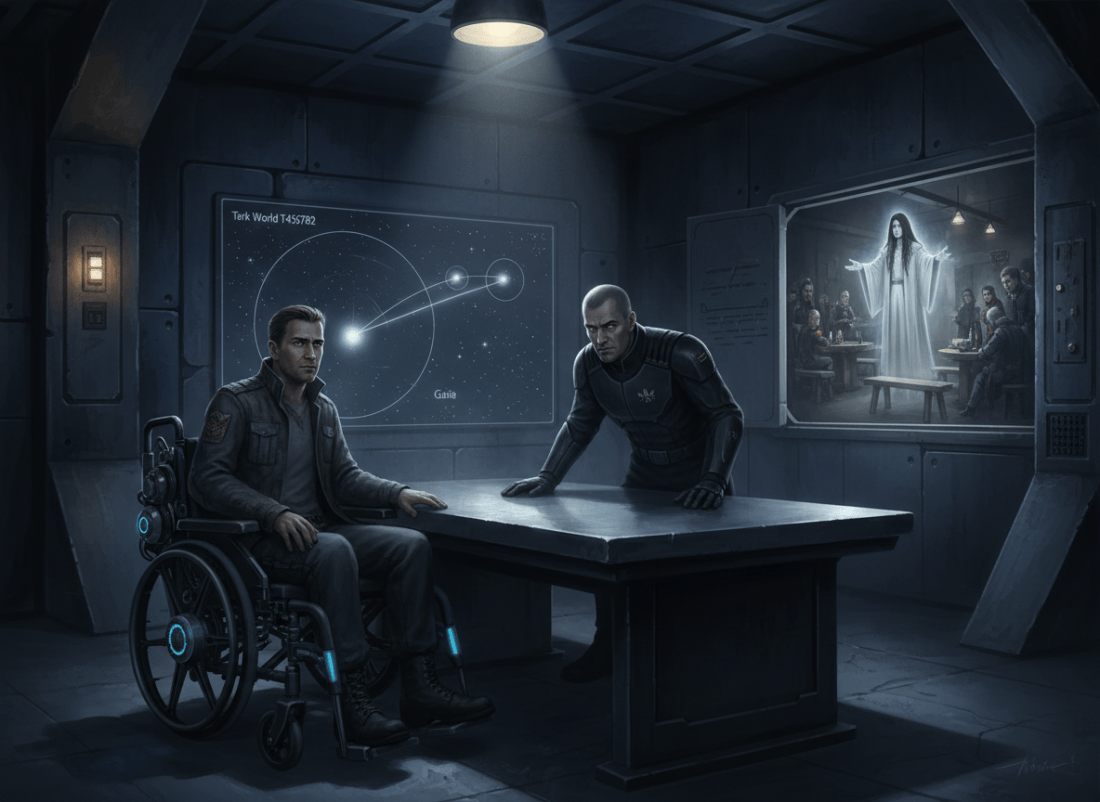
The days passed and Timothy and his troops grew to know what was a new world. Timothy was continually impressed. It had progressed beyond anything that he had expected. The only thing that bothered him was most of the progress was made after the Emperor’s grip on the planet had been loosened. This was not the way it way it should be. It was thought that the Emperor was the savior of humanity.

It was something of a shock that women were now treated on a par with men. In the latest wheelchair wars, they tried to reduce the bloodletting as much as possible. The poor’s health needs were met almost as much as those of the rich.

The Emperor’s ship had never left orbit. He sensed the nervousness of the people. They feared his return only slightly less than that of the impending Tyranid invasion. On a trip to the surface, he saw people pointing to its proximate location in the now blue sky.

He wondered if one of the Gods of Chaos was at work in the World but they were far from the Warp and the telepaths among his troops sensed nothing. A terrible truth dawned on him. They were doing better due to the Emperor’s absence.

He decided to rid his mind of such thoughts by focusing on the planet’s defense. After learning more, he was now quietly feeling more confident.

The planet had multiple lines of defense. The first was its multiple-battery orbit guns dotted around the planet. They were the best Timothy had ever seen. Almost too good. Who were they to be originally used against?

Then there was the planet’s federal army, which consisted of a land force, a navy, and a space force. The best troops in the land forces were modeled on the Space Marines and had undergone body augmentation and were fitted with the best lasers and blasters that money could buy.

The navy consisted of hundreds of battleships, aircraft carriers, and corvettes. The space force had nearly a thousand advanced fighters but no large ships.

There was also a territorial army, a large reserve force containing millions of men, albeit much more lightly armed with mostly machine guns and rocket launchers.

Finally, there were the militia. These had the poorest equipment and consisted of the young and old who were able to fight.

Now, it was a matter of finalizing exactly how the planet’s defenses would be used with the planet’s President.

Wheelchair Wars Part 3 (5)

It entranced him. The sheer scale of the human empire and all the different career opportunities in the army. So, he joined the Imperial Fleet and longed for war. At first, he thought that it would never happen, that all the battles were happening on the far edges of the Empire.

“But Trachtus five changed everything for me Timothy. Did you hear what happened there?”

“No, I didn’t,” Timothy replied, listening intently.

“A hole opened in the warp just outside the planet. The voices of chaos swayed the people and the 41st quadrant army against the Emperor. They were quickly reinforced by chaos marines. Such an abomination could not be allowed to stand.

We were sent to take back the planet. It was a very bloody experience, the resistance was fierce and durable. I lost so many good friends. I didn’t really understand war till then. Ninety percent of the population were against us.

As you will appreciate they all had to die. It was not something I had ever envisioned, killing women and children. other soldiers didn’t bother me. But it was the Emperor’s will.

I never hoped for war again because now I truly understood what it meant.”

Timothy noted the ominous tone in his voice.