Brian Clough, Johnny Giles and the Truth Behind The Damned United

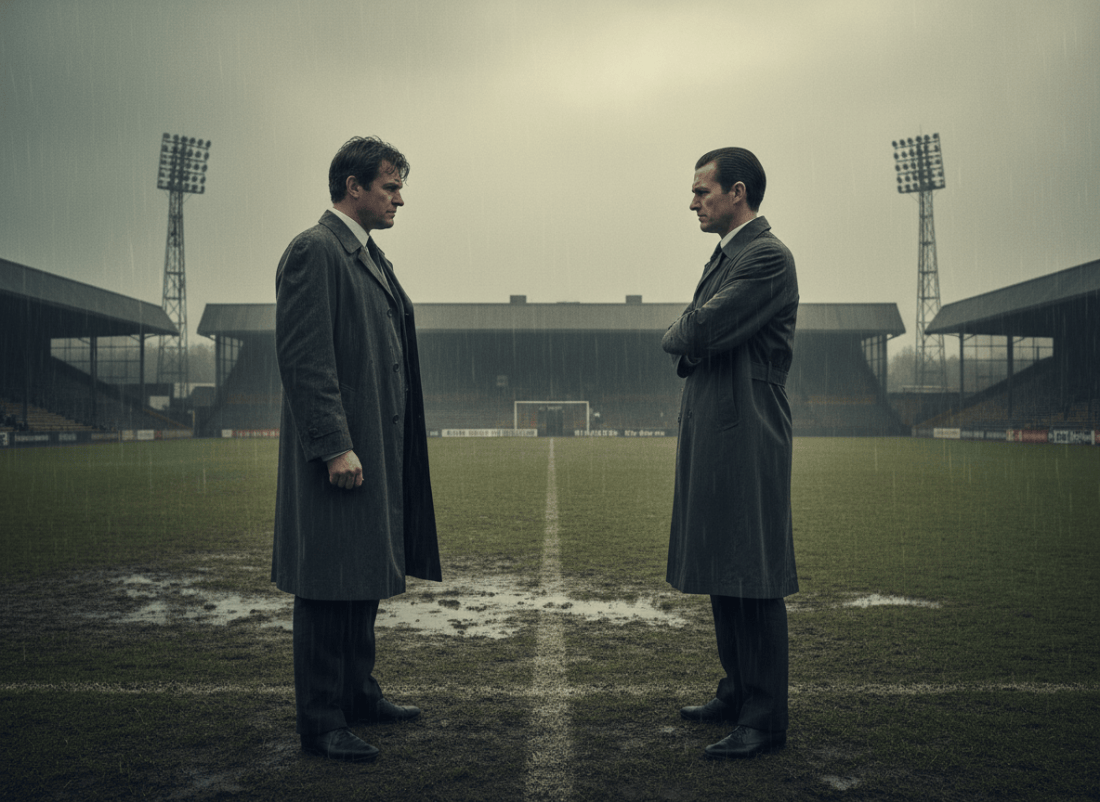
A cinematic, editorial-style historical football illustration inspired by the story of Brian Clough and Johnny Giles surrounding The Damned United: two serious 1970s English football managers in dark suits and coats standing on opposite sides of a rain-soaked football pitch, a moody stadium in the background, vintage documentary atmosphere, muted earthy colors, dramatic lighting, no text, no logos, no recognizable actor likenesses.

I finished watching this yesterday. In 1974, Brian Clough walks into Elland Road as the new manager of Leeds United, the champions he has spent years calling dirty, cynical, and unworthy. Don Revie has just left for England. The players are still Revie’s men. Peter Taylor, Clough’s indispensable partner, is not there. Forty-four days later, Clough is gone. The film and book both cut that short, doomed tenure against the earlier Derby County years, when Clough and Taylor turned a modest Second Division side into champions. The contrast is the engine: the rise explains the fall, and the fall makes the rise feel dangerous rather than merely triumphant.

What makes things more interesting from my perspective was that Johnny Giles was one of the Leeds players. He was a great pundit that I’m very familiar with so I was curious how he would be portrayed. And well, he isn’t really. Barely says a word but is something of a presence all the same. So, what did Giles think?

On the film specifically he said it was “a misinterpretation of the misinterpretation” of an already made-up book. He also called the portrayal of Clough “dreadful” and “scandalous”: Clough was shown as a raving lunatic who smashed Don Revie’s desk and drank heavily, none of which, Giles said, happened. He did not get on with Clough at Leeds (he found him rude and arrogant) but still felt the depiction was cruel to Clough and unfair to his family, who could not sue because Clough was dead. That, he said, was a major reason he took legal action himself: he was the only living person among those he felt were wronged who could do so.

Not exactly a ringing endorsement.

Still, I quite enjoyed it. It is barely a sports movie in the usual sense. There is mud, crowd noise, and the sour glamour of 1970s English football, but the real action happens in dressing rooms, boardrooms, hotel corridors, and the space between two men who need each other and cannot say so cleanly. Hooper and screenwriter Peter Morgan understand that Clough’s mouth was both his genius and his trap. The film is funny without becoming a joke, sharp without becoming a hatchet job, and surprisingly tender about the Clough–Taylor partnership. That relationship — part marriage, part double act, part management system — is the emotional centre, and Timothy Spall gives Taylor a wounded loyalty that makes Clough’s isolation feel costly rather than merely self-inflicted.

Michael Sheen is extraordinary. He gets the walk, the grin, the sudden freeze of the eyes, the way Clough could turn a compliment into a dare. More importantly, he gets the insecurity under the swagger. This is not a waxwork impression. It is a portrait of a provincial outsider who decided the world would have to fit him, then discovered that Leeds would not. Colm Meaney’s Revie is the perfect counterweight: padded, watchful, already a myth in his own club. Jim Broadbent, as Derby chairman Sam Longson, supplies the boardroom comedy and the slow-burn resentment of a man who backed a miracle and then wanted to own it. Around them, the film has the grain and damp of the period without drowning in nostalgia. The pitches look like battlefields. The offices look like places where careers actually end.

The themes travel far beyond Leeds. This is a story about succession, about what happens when a new leader inherits a family rather than a squad, and about the thin line between principle and vanity. Clough wants football to be cleaner, braver, more expansive. He also wants to win the argument with Revie. The film is wise enough to see that those two desires are not the same thing. Hatred, as several reviewers noted, can become a vocation. By the time Clough is telling champions to throw their medals in the bin, the line has stopped being moral instruction and become a man burning the only bridge that might have held.

It is also a love letter, of sorts, to a vanished English game: provincial clubs as civic engines, managers as public entertainers, success as something improvised rather than corporately managed. You do not need to care about the First Division table of 1974. You only need to care about people who cannot stop competing long enough to save themselves.

Three point five stars out of five from me.
Why Goodfellas is a Timeless Crime Classic

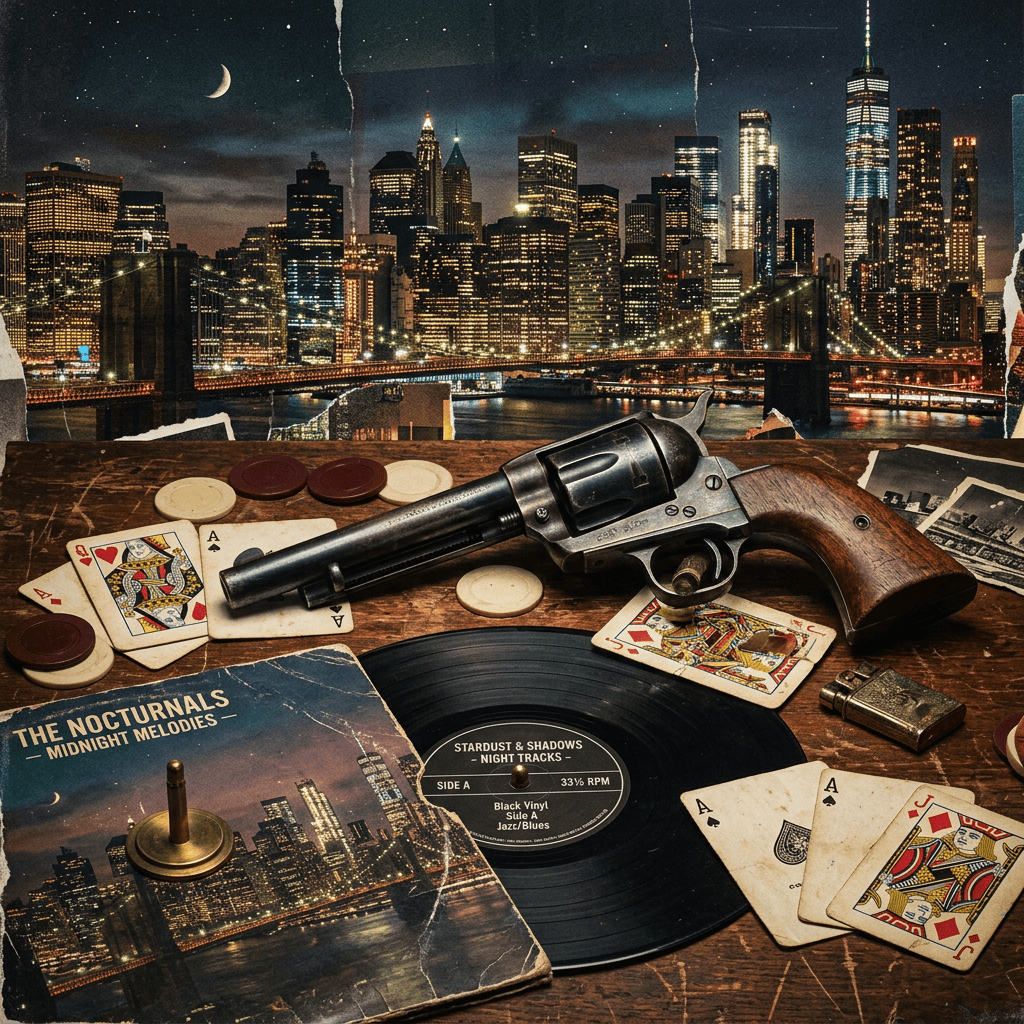
Vintage revolver, playing cards, poker chips, and vinyl records on a wooden table with city skyline at night

I was recently flicking through the TV when I came across this film. It’s up there with my favorite films of all time and I recommend you watch it if you have not already done so.

Goodfellas is a masterclass in filmmaking—a relentless, exhilarating, and brilliantly crafted immersion into the seductive, brutal world of organized crime that remains one of the greatest American movies ever made.Martin Scorsese’s 1990 adaptation of Nicholas Pileggi’s nonfiction book Wiseguy follows the rise and eventual unraveling of Henry Hill (Ray Liotta), a half-Irish, half-Sicilian kid from Brooklyn who grows up idolizing the local mobsters and eventually becomes one of them. From the opening freeze-frame and that iconic line—“As far back as I can remember, I always wanted to be a gangster”—the film announces its confidence and energy. It never lets up.

What elevates Goodfellas above almost every other crime film is Scorsese’s electrifying direction and the seamless collaboration with editor Thelma Schoonmaker. The camera is constantly alive: tracking shots that glide through the Copacabana in a single unbroken take, freeze-frames that punctuate Henry’s narration, and rapid-fire cuts that mirror the characters’ high-wire lifestyle. The famous long take through the back entrance of the nightclub is pure cinematic joy—glamour, status, and danger all distilled into one fluid movement. The film’s pacing is propulsive yet precise, shifting from exhilarating highs of easy money and loyalty to the paranoid freefall of the later years without ever losing the audience.

The performances are uniformly outstanding. Ray Liotta gives Henry Hill a magnetic everyman quality; you understand exactly why the life pulls him in even as you watch it corrode everything around him. Robert De Niro’s Jimmy Conway is cool, calculating, and quietly terrifying—a masterclass in restrained menace. Joe Pesci’s Tommy DeVito is unforgettable: volatile, hilarious, and explosively violent in equal measure. His “Funny how?” scene remains one of the most perfectly calibrated moments of tension and dark comedy in cinema. Lorraine Bracco brings real emotional weight as Karen Hill, grounding the story in the personal costs of this lifestyle, while Paul Sorvino’s Paulie Cicero radiates quiet authority and paternal menace.

The screenplay, co-written by Scorsese and Pileggi, is razor-sharp. The voice-over narration feels conversational and confessional rather than explanatory, pulling the viewer into Henry’s perspective so completely that the moral compromises register as almost inevitable. The dialogue crackles with authenticity—streetwise, funny, and often casually cruel. Scorsese never romanticizes the violence, but he also refuses to look away from the intoxicating pull of power, money, and belonging that the life offers.

The soundtrack is legendary. Scorsese’s needle-drops—ranging from Tony Bennett and Cream to the Rolling Stones and Sid Vicious—function almost as additional characters, underscoring mood, era, and emotional undercurrents with uncanny precision. Combined with Michael Ballhaus’s rich cinematography and the meticulous period detail, the film feels fully lived-in and alive.

Goodfellas is more than a crime story; it is a study of ambition, loyalty, betrayal, and the American Dream twisted into something dangerous and irresistible. It captures the intoxicating rush of the early days and the inevitable decay that follows with equal clarity and style. Three decades on, it still feels fresh, urgent, and unmatched in its energy and craftsmanship.

Five stars out of five.

A few years ago, there was a documentary about what happened to Nicholas Pilegg after the film ended. He ended up going back to the life while in witness protection. What a legend.

Pegasus (Part 90)

Previously, I read about entering Earth’s atmosphere but to experience it is another. The shaking grew larger, and I could see the heat shield at the front glowing red.

Then, everything was still again. Tabitha shouted out her approval. We were coasting now in the Earth’s upper atmosphere. The sky was beautiful blue. The toxic grey clouds that covered most of the planet were like a carpet below us. We were going to try and avoid them altogether.

That carpet gradually faded, then disappeared giving us our first opportunity to see the tainted purple sea. Tabitha was thrilled. “Do you think there is anything alive down there?”

I didn’t want to crush her dreams.

“Yes, I’m sure there must be something. What exactly, I don’t know.”

And maybe there was. I had serious doubts though.

A few minutes later, the sea turned to sand.

“We must be close,” Tabitha said.

“Another ten minutes or so.

The ruins of London were something else. They became visible as jagged pieces sticking out of the land in the distance. They drew closer and what were a few pieces, grew into a sea of its own. Tabitha scanned the vicinity for movement.

“Nothing, apart from some rats.”

Galway Girls Part 20

Once I had quenched my thirst and filled my stomach, thoughts turned to what we would do next. Sean said that he had to head back to work but that myself and Ronan should have a walk around the town.

“Yeah, that would be a good idea Paul,” Ronan interjected, “I’d like to wait another hour or two to make sure I’m under the limit.”

I nodded in agreement.

Sean headed off and we made our way through the bustling city. Galway is a mixture of the old and the new with the sound of music coming from the many buskers on the streets that are pedestrianized.

We pass over the mighty Corrib. It has a fast flow and I pause and admire its rapids. The sweet smell of the sea entered my nostrils.

But all the time my mind kept drifting back to the previous night. The thought of her on top of me, her soft breasts. Then Ronan snapped me back to reality pointing out we were close to where we’d been the previous night.

After a while, we stopped to have a coffee in one of the many coffee shops that dotted the place. They are mostly small and quaint, with smiling staff.

As Ronan went to the counter, I finally opened the note that had been left for me that morning –

Message me Leslie Xxx 087-65XXXXX

Now, what should my first message be?