
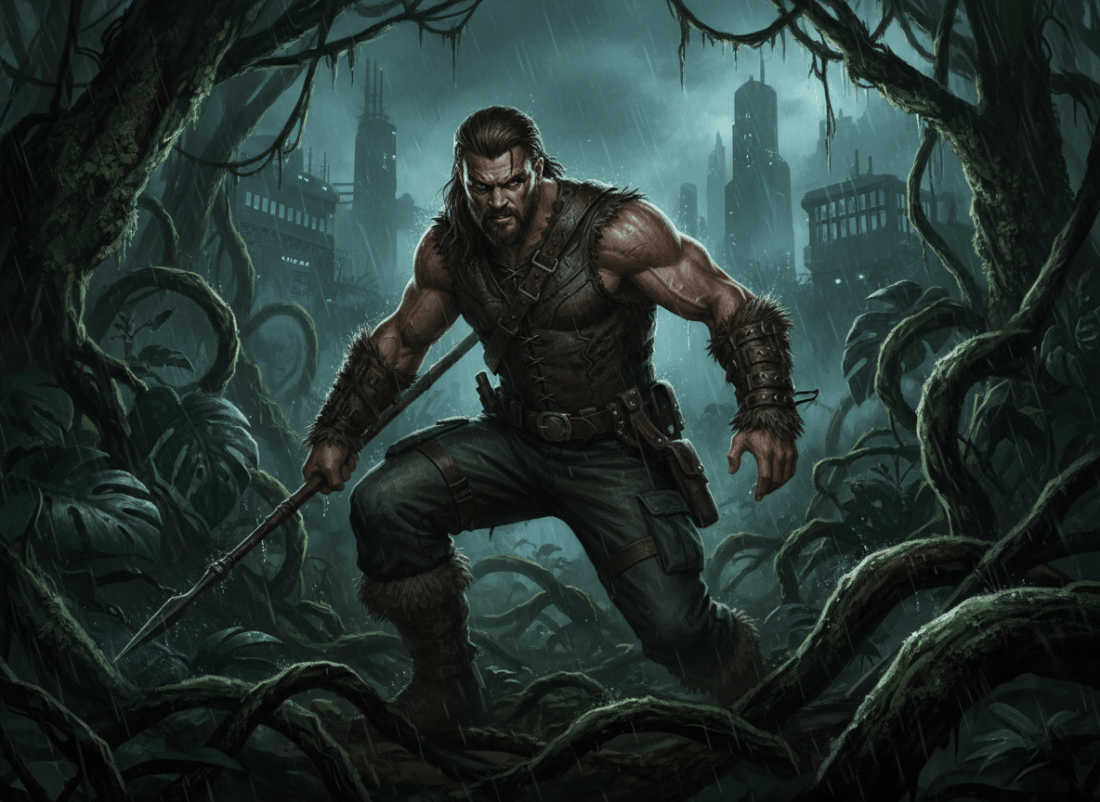
I watched this film yesterday, and have quite mixed feelings about it.
Kraven the Hunter is the rare Sony Spider-Man spinoff that almost knows what kind of movie it wants to be, then keeps tripping over the same roots that sank Morbius and Madame Web. J.C. Chandor’s R-rated origin story, released in December 2024, is messy, frequently silly, and visually uneven. It is also bloodier, more committed to its pulp, and occasionally fun.
Aaron Taylor-Johnson plays Sergei Kravinoff, the estranged son of a Russian crime boss who becomes a vigilante hunter of evil men after a lion mauling and a dose of mystical blood give him animal strength, speed, and senses. The film opens with him already operating as an urban legend, then flashes back to a hunting trip in Tanzania with his father Nikolai (Russell Crowe) and softer half-brother Dmitri (Fred Hechinger).
From there it piles on Ariana DeBose’s Calypso, Alessandro Nivola’s Aleksei Sytsevich (the future Rhino), and Christopher Abbott’s Foreigner, before setting up Dmitri as the Chameleon. Screenwriters Richard Wenk, Art Marcum, and Matt Holloway treat the comic-book villain as a brooding antihero with a father complex, which is the right instinct and the wrong dosage.W
hat works is mostly physical. Taylor-Johnson sells the hunter fantasy with real commitment: barefoot climbs, knife work, and a prison sequence that at least has a pulse. The R rating is not decorative. People get mauled, stabbed, and thrown through environments in ways the PG-13 Sony spinoffs never allowed, and for a while that brutality gives the movie a meaner identity than “generic enhanced guy.” Crowe, chewing through a thick accent and a philosophy of dominance, is the most entertaining person on screen whenever he appears; he understands he is in a pulp gangster picture wearing a Marvel badge. Abbott’s Foreigner is similarly slippery and odd, the kind of supporting villain who briefly makes the film feel like it has a personality.
A London chase built around Dmitri’s kidnapping is the clearest evidence that Chandor, better known for Margin Call and All Is Lost, can stage momentum when the effects and geography cooperate.The problems start as soon as the movie has to explain itself. The mythology is a grab bag: lion blood, a family sanctuary, a lawyer who somehow becomes Kraven’s partner in a hit list, and a Rhino subplot that exists mostly so the third act can have a monster.
Accents wander. Calypso is underwritten to the point of comedy; DeBose is stranded with exposition and a personality that never arrives. The special effects, especially anything involving animal movement or Rhino’s transformation, often look unfinished, and critics were right to call out the spatial emptiness of the fights. T
he much-mocked climax, a short mud brawl in a field, is the movie admitting it has run out of ideas. Kraven’s moral position is also fuzzy in a way the script never resolves: he is introduced as the man who only hunts the wicked (but kills men who have done no more than trophy hunt at one point) , then spends the runtime proving he shares more of his father’s appetite than he will admit, without the film committing to either tragedy or satire. That last point is the real missed chance. Classic Kraven stories work because he is a predator with a code who eventually wants the one quarry who can beat him. This film never has Spider-Man, never really needs him for the plot it tells, and still feels shaped by the contractual absence.
The result is an origin that ends by gesturing at a larger universe (Chameleon, a harder Kraven) the box office made irrelevant. Compared with the rest of Sony’s spider-free web, it is less inert than Madame Web and less meme-dead than Morbius, which is faint praise and also true. Put your brain in park and the animal-man set pieces, Crowe’s ham, and the R-rated nastiness can carry an evening. Three stars out of five.

