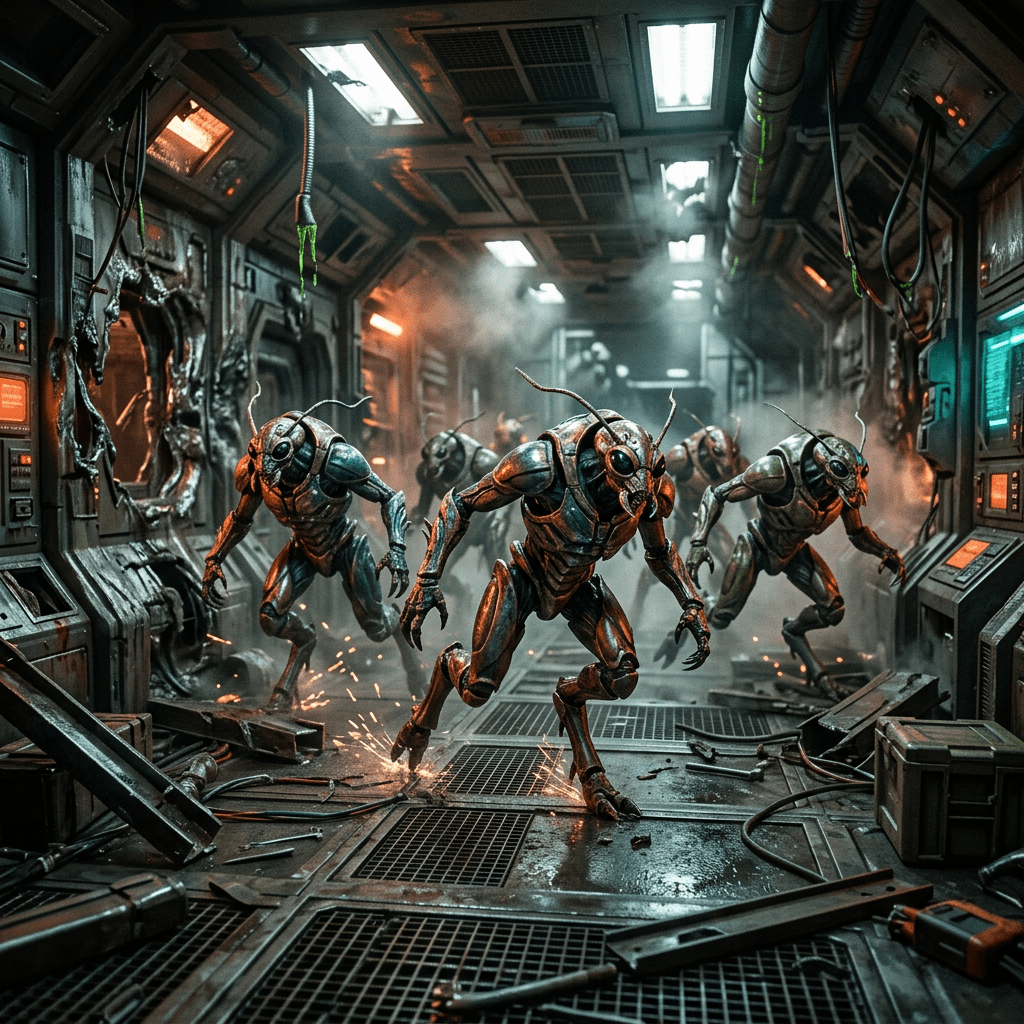
Wheelchair Wars (iv)

Once placed on the battle chair, Audrey activated it by pressing the top of her joystick. The flipper swung up in front of her.

Oreus grinned. “Splendid, isn’t it. The finest engineering went into it to ensure the maximum lift. The rest will be open to you.”

Audrey nodded and went back out to the main hall. Where once there was boisterous chatter, now there was silence. She looked around as all eyes fell on her. Then there were gasps of awe.

A group of them then approached. A male voice was the first to speak, but she was unsure of whom. “How did ya get that?”

Audrey spoke with a big smile on her face. The whole was listening. “I’m to test it for Oreus. Who wants to battle?”

Shadows on the Road: Tracking the Child Snatcher Through Nine Years of Terror

This documentary may not be everyone’s cup of tea. It tells the story of the hunt for serial killer Robert Black, his four child victims, and their families.

Robert Black (21 April 1947 – 12 January 2016) was a Scottish serial killer and paedophile who was convicted of the kidnap, rape, and murder of four girls aged between 5 and 11 in a series of crimes committed between 1981 and 1986 in the United Kingdom.

Black was convicted of the kidnapping, rape, and murder of Susan Maxwell, Caroline Hogg, and Sarah Harper on 19 May 1994. He was also convicted of the attempted kidnapping of a fourth girl and had earlier been convicted of the kidnapping and sexual assault of a fifth. He was sentenced to life imprisonment, with a recommendation that he serve a minimum of 35 years.

In 2011, Black was further convicted of the 1981 sexual assault and murder of nine-year-old Jennifer Cardy. At the time of his death in 2016, he was regarded as the prime suspect in the 1978 disappearance and murder of 13-year-old Genette Tate. Black may also have been responsible for several other unsolved child murders in Britain, Ireland, and continental Europe between 1969 and 1987.

Manhunt: The Child Snatcher is a gripping and expertly crafted documentary that delivers both emotional depth and investigative intensity. From its opening moments, the film draws viewers into a chilling case, striking a balance between suspense and sensitivity that feels both responsible and compelling.

The investigative angle is particularly strong. The documentary offers insight into the tireless work of law enforcement and the complexities of tracking down a dangerous predator. It highlights the human element behind the badge — the persistence, frustration, and determination involved in pursuing justice. This focus adds depth and authenticity, elevating the film beyond a standard true-crime recounting.

Of particular note, it details how the use of computers, novel at the time, was of great assistance in showing patterns that would be impossible to see otherwise. This was before CCTV took off. They used receipts that the killer had meticulously collected to follow his past movements.

Visually and technically, the production is polished and immersive. The use of atmospheric music, well-edited reenactments, and carefully chosen interview settings creates a somber yet engaging tone. The cinematography reinforces the emotional weight of the story without overpowering it.

Ultimately, Manhunt: The Child Snatcher is more than a crime documentary — it’s a powerful exploration of resilience, community response, and the pursuit of justice. It’s haunting, informative, and deeply affecting, leaving a lasting impression long after the credits roll.

Five stars out of five from me. Be prepared to shed a few tears.

Wheelchair Wars (iii)

Oreus nodded to his men, and they lifted Audrey into one of the Falcon Xs. Her face blossomed into a smile.

“Go on, Audrey, have a spin around. You have her for your next battle.”

Audrey pressed the joystick forward. Her hair blew from the acceleration, and her eyes opened wide. She zipped around the chamber.

When she came close, Oreus, began to speak once more, “Halt, Audrey. You can practice with the others for the rest of the day, but first, I would like to discuss your next opponent. He has many kills to his name. But you now have the superior battle chair. I have a suggestion for the tactics you should use.”

Audrey nodded for him to continue.

“It’s a weapon that you have not used before – The flipper. You need to maneuver your chair so that it slips under one of his wheels, and then flip his battle chair onto its side. Then finish him, knowing that he has killed many Na Fianna.”

“It would be my honor, for both you and Na Fianna.”

Oreus grinned and instructed his men to affix the weapon to the battle chair. They retrieved it from one of the walls that was adorned with weapons and joined it to the front of the chair in seconds.

Distant Love (Part 65)

Derek’s muscles clench. He looks around the quaint coffee shop to make sure nobody is watching him. “What in the lunar happened. Like seriously, this couldn’t possibly have been part of the plan?”

For the first time, Derek sees that Diane is nervous. Her hands shake as she struggles to lift a coffee, her eyes averting his.

They had arranged to meet just over an hour ago. Maeve had been arrested hours earlier after the crash on the lunar surface.

“It wasn’t supposed to happen like that. We didn’t think that the flare would damage the ship to that extent; it should have been retired decades ago, obviously.”

Derek’s face was becoming a deep red. “You could have killed them all.”

They both quieten as a robotic server passes.

Derek scratches his hand. “This is such a mess up. It really is. And what now? What happens to Maeve?”

For the first time, their eyes meet before Diane continues. “She is not being forthcoming, claiming that she knows nothing. Her mother will flinch to save her, but we need more.”

“Perhaps, she doesn’t know anything? Have your people thought of that?”

“Of course she does. Don’t be an idiot. I don’t think she’ll be forthcoming here, though. That’s where you come in.”

Jurassic World Rebirth: Stunning Visuals and Engaging Characters

My dear readers, I have something quite painful to admit. I’m old enough to remember seeing the original Jurassic World, way back in 1993. It was different from anything I’ve seen before, and the memory stayed with me. So, when I saw the latest Jurassic film was out, I immediately recorded it to watch today.

Jurassic World Rebirth is a 2025 American science fiction action film directed by Gareth Edwards and written by David Koepp. It is the fourth Jurassic World film, as well as the seventh installment overall in the Jurassic Park franchise. The film features Scarlett Johansson, Mahershala Ali, Jonathan Bailey, Rupert Friend, Manuel Garcia-Rulfo, and Ed Skrein.

In Jurassic World Rebirth, the world’s de-extinct dinosaurs live around the equator, which provides the last viable climate for them to survive. The reasons given for this is modern diseases, needing a warm climate, and there being more oxygen to survive. All of which is pseudoscience, to create the world they want for the film. Any disease wiping them out would have to be across completely different species, very unlikely. There is not appreciable more oxygen at the equator, and even there, the temperature would be cooler than the Jurassic. But I digress.

A team travels to a former island research facility where three specific gigantic species of dinosaurs reside, to extract samples that are vital for a heart disease treatment. The team also rescues a shipwrecked family, and both groups struggle to survive after becoming stranded on the island.

Visually, the film is nothing short of spectacular. The cinematography captures both the majesty and terror of these prehistoric giants with stunning clarity. Lush landscapes, sweeping aerial shots, and intimate ground-level chases create a dynamic sense of scale. The dinosaurs themselves have never looked better — each creature is rendered with remarkable detail and personality. Whether it’s a tense standoff in a dense forest or a pulse-pounding urban pursuit, every action sequence is crafted with precision and restraint, making the danger feel real and immediate.

What truly elevates Jurassic World Rebirth above previous iterations is its character work. The ensemble cast delivers grounded, emotionally engaging performances that give weight to the spectacle. The protagonists feel layered and human, grappling with responsibility, fear, and hope in ways that resonate beyond the screen. Their arcs intertwine seamlessly with the film’s larger themes about scientific ambition, ecological balance, and second chances.

The cast is a major upgrade. Scarlett Johansson brings sharp intelligence and physicality to Zora, making her a compelling, resourceful lead who carries the action without ever feeling like a Pratt stand-in. Mahershala Ali as Duncan Kincaid provides gravitas and quiet strength—his chemistry with Johansson grounds the team dynamic beautifully. Jonathan Bailey (fresh off Wicked and Bridgerton) shines as paleontologist Dr. Henry Loomis, injecting warmth, wit, and nerdy enthusiasm that reminds us why we fell in love with these stories in the first place. The supporting players, including Rupert Friend as a slick Big Pharma rep and Manuel Garcia-Rulfo as a shipwrecked civilian dad, add layers of conflict and humanity without ever slowing the pace.

The film gets five stars out of five. Relive your childhood.

Paradise (2023) – A Thought-Provoking Sci-Fi Thriller That Hits Close to Home

My dear readers, you are all aware of my affection for sci-fi. This particular German film relies on the premise that you can transfer lives left to live from one person to another, exploring the moral ambiguities that might arise from such a transfer. Personally, I think that humans will live far longer in the future, but I don’t think this is a plausible way for this to be done.

Still, let’s roll with it.

Paradise is a German dystopian science fiction thriller directed by Boris Kunz, released in 2023. The film stars Kostja Ullmann, Corinna Kirchhoff, Marlene Tanczik, and Iris Berben. It was released on Netflix on July 27, 2023.

The biotech startup Aeon, under the leadership of its founder Sophie Theissen, has grown into a multi-billion-dollar corporation. The company transfers years of life from young people to willing donors through a medical procedure, who are financially compensated. The procedure requires unspecified genetic matches between donor and recipient, cataloged through cheek swabs. A collective known as “The Adam Group” opposes Aeon’s technology and actively and violently opposes it. Their leader, Lilith, and her followers carry out several attacks on recipients of transferred life years.

Max Toma, an Aeon representative, persuades people to part with their years. He speaks from personal experience, having traded five years of his life to finance his studies. Max is a staunch supporter of his employer and appreciates the obvious benefits of the age exchange. His work has allowed him and his wife, Elena, to afford a luxurious apartment. He is unaware that his wife has pledged 40 years of debt as a condition of the loan. When their apartment burns down, the insurance company refuses to pay, arguing that the cause was Elena’s carelessness. She is forced to give up forty years of her life.

Max, perhaps belatedly, sees the evil of the system and tries to undo what has been done.

Kostja Ullmann delivers a compelling performance as a man whose loyalty to the system is tested when the consequences become personal. His transformation feels authentic, layered, and emotionally earned. Opposite him, Corinna Kirchhoff brings gravitas and intensity, grounding the film in emotional realism even as the stakes escalate.

The chemistry between characters adds depth to what could have been a purely conceptual thriller. Instead of being overshadowed by its premise, the film keeps its focus on relationships, choices, and moral responsibility.

Kunz directs with confident pacing, blending sleek corporate aesthetics—cold blues, sterile labs, and luxurious high-rises—with gritty, rain-soaked streets that underscore the societal divide. The visual style effectively mirrors the film’s themes: glossy surfaces hiding ugly truths. Several sequences, particularly the tense surgical transfer scenes and the climactic confrontations, are shot with taut intensity that keeps you on edge without relying on over-the-top action.

Thematically, Paradise excels at asking uncomfortable questions about privilege, exploitation, and the commodification of human life. It draws clear parallels to real-world issues like debt traps, healthcare inequality, and the gig economy’s toll on well-being, without feeling preachy. The script (by Kunz, Simon Amberger, and Peter Kocyla) builds tension through revelations that feel earned rather than contrived, culminating in a finale that packs emotional and philosophical punch.

The film ends somewhat unsatisfactorily, though, perhaps a sequel is expected.

The film gets three stars out of five for me.

The Swedish Connection: A Hidden WWII Hero

My dear readers, this is a Swedish film about a quiet, undeclared hero. The Swedish Connection (Swedish: Den svenska länken) is a World War II drama about Swedish foreign ministry bureaucrat Gösta Engzell, who develops and executes covert plans to rescue European Jewish refugees by using legal loopholes and paperwork. Released in 2026, the film stars Henrik Dorsin as Engzell and was directed by Thérèse Ahlbeck and Marcus Olsson.

It is a remarkable true story about what great things an ordinary person, not in the limelight, can achieve. It’s 1942, and neutral Germany is surrounded by Nazi Germany and its erstwhile ally Finland. A Swedish bureaucrat and his Department are doing everything they can, at times against the wishes of their government, to save as many Jews as possible by providing a connection to Sweden, and thus released.

Henrik Dorsin delivers a wonderfully nuanced performance as Engzell, portraying a man who starts the story mired in rules and paperwork but grows into an unexpected moral force. His journey, guided by humanity rather than headline-making heroics, is one of the film’s most rewarding elements — it reminds us that heroism doesn’t always wear a uniform or charge into battle; sometimes it quietly persists behind desks and in government halls. Sissela Benn as Rut Vogl brings warmth, intelligence, and emotional grounding, making her interactions with Engzell some of the most heartfelt moments onscreen.

The film’s tone is another notable achievement. While it doesn’t shy away from the horrors of the Holocaust backdrop, it also finds space for hope, humility, and even light touches of humor. The result is a heartfelt, uplifting experience that honours its real-life subjects without ever feeling exploitative or overly sentimental.

The provisional visa process pioneered by Engzell’s team are credited with rescuing 100,000 Jews during the war.

Unfortunately, the Irish Government did nothing similar, when perhaps thousands more could have been saved.

Five stars out of five for me.

Wheelchair Wars (ii)

There were men and women in wheelchairs, whichever way she looked. Their wheelchairs were armed, though with all manners of swords, hammers, and knives.

“Audrey” reverberated through the hall. It was Oreus, sitting imperiously in a battlechair, with two muscle-bound men at each side. She goes towards him, her heart throbbing.

“Yes, ssirr.”

He looked at her with contempt. “You must speak with conviction if you want to be a warrior. Demand respect.”

“Yes, sir,” she replied, her tone raised.

“Better.” He looked her up and down. “You have good control of your chair. Spatial awareness is as important as savagery. Without either, there is little hope of you lasting long.”

He scrunched his face. “Your next opponent is going to be formidable. I watched as his last opponent pleaded for his life. The crowd laughed.”

Oreus stared at Audrey, but she didn’t flinch.

She has the fire.

“Follow me.”

Oreus drives his chair to a narrow side tunnel, then down a long, downward ramp, using his jaw, with his goons and Audrey following closely behind. The din of chatter dissipates behind them.

They enter a large, cool chamber filled with rows of battlechairs of various makes, shapes, and sizes. Oreus led them to the back of the room. “This is the Falcon X.”

Audrey’s face lit up. “Is it as good as they say?”

Oreus smiled. “That’s what I want you to tell me.”

Exploring the Culper Spy Ring in Turn

Hello dear readers, I’m back to report on the Series Turn. It’s four series long, so it took a while. But it was worth it. You might wonder why I don’t give too many low ratings. Simples. If I don’t like something, I stop watching. And I loved this.

At the risk of repeating myself, Turn: Washington’s Spies (originally titled Turn and stylized as TURИ: Washington’s Spies) is an American period drama television series based on Alexander Rose’s book Washington’s Spies: The Story of America’s First Spy Ring (2007), a history of the Culper Ring.

The story covers events from 1776 to 1781 and features a farmer from Setauket, New York and his childhood friends. They form an unlikely group of spies called the Culper Ring, which eventually helps to turn the tide during the American Revolutionary War. The series begins in October 1776, shortly after British victories, recapturing of Long Island and the Port of New York for the Crown, leaving General George Washington’s army in dire straits.

But it’s going to be a long and bloody war.

It is an engaging, atmospheric historical drama that blends espionage, character-driven storytelling, and Revolutionary War intrigue into a series that is both entertaining and surprisingly educational. It’s one of those shows that manages to feel fresh even when dealing with well‑known historical events, largely thanks to its focus on the lesser‑known Culper Spy Ring and the ordinary people behind it.

It is full of twists and turns that keep the audience fully engaged.

Samuel Roukin as Captain John Graves Simcoe gives a great, memorable performance. He comes across as quite the psychopath, bringing fear even to those on his own side.

The overall narrative strikes an appealing balance between historical accuracy and dramatic tension. While the series takes creative liberties, the core storyline is grounded enough to feel authentic.

Highlights:

  • The slow-burn pacing allows character motivations and relationships to develop naturally.
  • The spycraft elements—coded messages, invisible ink, dead drops—are fascinating without feeling overly dramatized.
  • The show explores moral ambiguity, portraying both sides of the war with nuance and complexity.

The finale is a clear example of this. A war of good and evil was not fought between Britain and the UK, but in the souls of individuals themselves. America won the war, resulting in some being returned to slavery. Simcoe went on to become the Governor of a part of Canada and ended slavery in the area.

Five stars out of five from me.

A Knight of the Seven Kingdoms: A Must-Watch Review

My dear readers, I previously wrote about my initial impressions of this series a few weeks ago. Well, now that I’ve finished watching it, I can tell you it’s a must-watch. Just like Game of Thrones, it’s a slow starter but many of the final episodes are simply brilliant, especially the one where he is forced to fight the prince.

It stars Peter Claffey as Ser Duncan “Dunk” the Tall, the titular hedge knight, and Dexter Sol Ansell as his squire Aegon “Egg” Targaryen. Their relationship is central to the series rather than wars or dragons. Dexter Sol Ansell, in particular, gives a great performance. It turns out that he is actually a prince, both saving and complicating life for Dunk.

The writing is sharp and thoughtful, staying true to George R. R. Martin’s storytelling style — rich with political nuance, moral complexity, and understated tension. Every tournament, roadside encounter, and noble court carries weight, but the stakes feel personal rather than apocalyptic. It’s a refreshing change that allows the characters to breathe and grow.

The fighting scenes are excellent and fill you with dread, full of gore and pain.

What truly sets Series 1 apart is its tone. There’s humor here — gentle, character-based humor — alongside moments of quiet reflection and moral dilemma. It reminds us that heroism in Westeros isn’t about destiny or prophecy, but about choices.

In short, A Knight of the Seven Kingdoms Series 1 is a beautifully crafted, character-focused story that expands the world fans love while standing confidently on its own.

It gets five stars out of five from me.