Magnus Carlsen’s Dramatic Face-off: A Netflix Review

Chess pieces on a board with a tornado and lightning storm in the background

My dear readers, as you may all have gathered by now, I love Chess. So when I saw Chess Mates on Netflix, I immediately watched.

It revolves around Magnus Carlsen, the undisputed greatest chess player of his generation, facing off against Hans Niemann, a brash young American talent who rose through online chess during the pandemic boom. What starts as a dramatic over-the-board victory quickly spirals into one of the most bizarre and talked-about controversies in modern sports history.

Magnus Carlson is convinced that the young Hans cheated. The first question that arises is how. They search for devices before each match.

It deals with the Carlsen-Niemann scandal with such intelligence, balance, and cinematic flair that it feels more like a high-stakes thriller than a standard sports doc. From the very first minutes, the film hooks you. It masterfully sets the stage:

The production quality is outstanding. Netflix spared no expense with crisp archival footage, sharp interviews, and smooth pacing that keeps the nearly 75-minute runtime flying by.

The directors weave together player interviews, expert analysis from grandmasters, journalists, and even some of the wild online speculation (yes, including the infamous “anal beads” rumors) without ever feeling exploitative. They let the story breathe while providing real context about the pressures of elite chess, the explosion of online play, and the challenges of proving (or disproving) cheating in a game where engines are stronger than any human.

I was particularly impressed by how even-handed the documentary feels. It gives both sides a voice — Carlsen’s deep frustration and skepticism, Niemann’s defiant personality and claims, and the broader chess community’s divided reactions. No cheap villain-making here; instead, it explores the human elements: ego, genius, paranoia, ambition, and the blurry line between intuition and suspicion at the highest levels.

The talking heads are excellent — thoughtful, articulate, and sometimes refreshingly candid. The way the film builds tension around key games, analyzes critical moments without drowning non-chess players in notation, and examines the aftermath (including the lawsuit and lingering bad blood) is superb. Even if you only have a passing interest in chess, the universal themes of rivalry, trust, and scandal make it incredibly accessible and entertaining.

Overall, I was more inclined to agree with Niemann. Carlson comes across as very smug to me. The fact that Niemann cheated online when he was 16, 17 hardly proves much. Lots of people cheat at that age I’m sure. At leasr he wasn’t on drugs, right.

This gets four out of five stars from me.

Oreus 2 part (v)

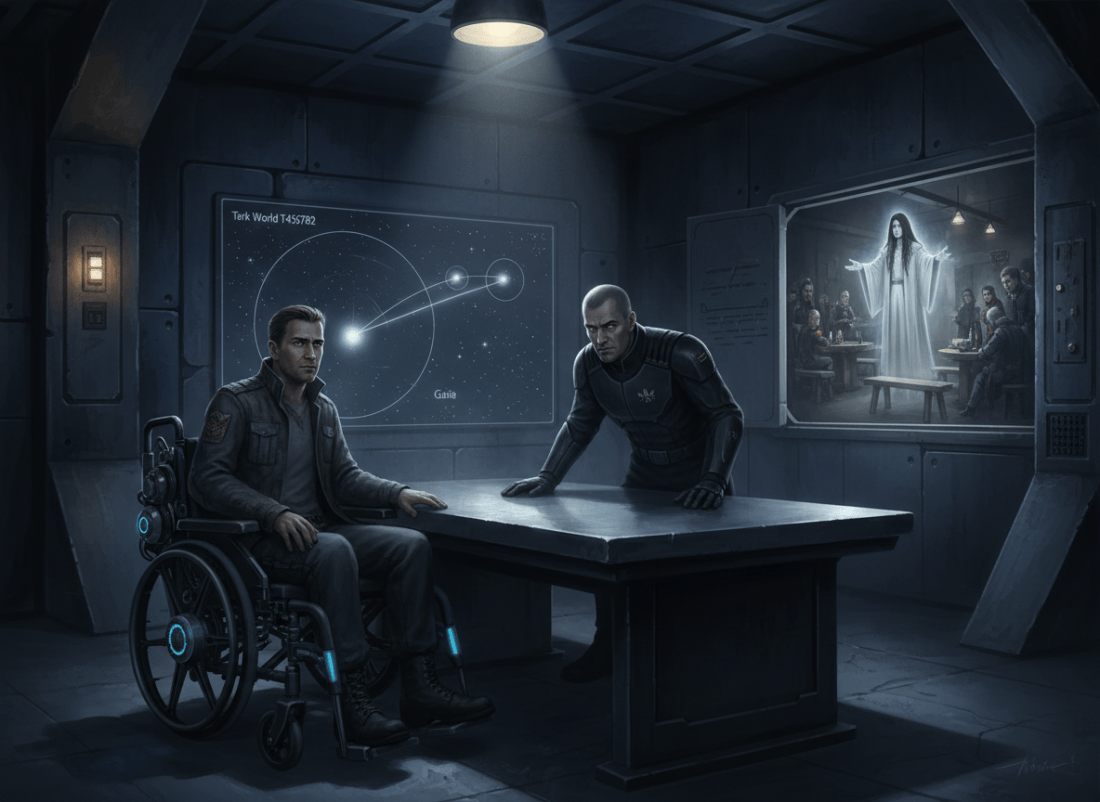
Soldiers in combat-ready wheelchairs strategizing around a holographic table in a wasteland bunker.

Oreus glared. “You cannot be serious! The Fianna Warriors will be torn to shreds.”

The Governor’s eyes narrowed as he stared back. “Do you think you know better than the Emperor’s representative?”

Looking downwards Oreus replied, “No, of course not. It’s just that it would be over too fast. What entertainment would there be?”

Brigid grinned. “Remove the weapons restriction. That should liven things up a bit.”

The Governor slammed his hands on the table. “Done. Now, how do we get our a Gargantuan?”

Oreus felt sick as the conversation switched to how exactly the Gargantuan would be procured. The name Galvius was mentioned and then various prices. But it all blurred into his background.

“What do you think, Oreus?” The room went quiet. The Governor was looking right at him.

Oreus shuffled in his seat. “It all sounds in order.”

The Governor took a fit of coughs. “Good, then it is all settled. You can inform your warriors of their next challenge. Let’s hope they can make it interesting. That is all.”

The Governor, took a step back, then left followed by the others. At all Oreus made sure that he was ready to fire, just in case. Better to be seeking forgiveness than dead. He was last to leave, shaking his head in disbelief.

A Gangster’s Life Review: Charm and Chaos in British Crime Comedy

Silhouettes of two men facing each other, one aiming a gun, with police tape and cracked background

If there one that the British are good at, it gangster films. Who could ever forget Lock, Stock and two smoking barrels?

So, I was eager to see if this latest film lived up to my expectations. Unfortunately, it didn’t.

A Gangster’s Life (2026) is a low-budget British crime comedy-drama directed by Zak Fenning (his feature debut), written by Roy Rivett, and released digitally in the UK on January 19, 2026, via Miracle Media. It runs for over 90 minutes.

It has a strong start, with two low level gangsters on the verge of being tortured for scamming a ruthless London mob boss. When he discovers how they did it though, he puts business first and they are forced to join his gang. They decide the only way to escape is to do a double scam and flee to Greece, where they believe they will be safe.

The story mixes gritty London gangland tension with fish-out-of-water moments abroad, blending crime caper elements, dark humor, power struggles within the mob, and some attempts at character-driven drama.

The film’s biggest assets are its central performances and occasional bursts of charm. Tony Cook and Jonny Weldon make a solid double act as the mismatched duo—Cook channels a Jason Statham-like tough-guy charisma with his bald-headed, accented presence, while Weldon leans into the comedic potential of his character’s unfortunate name (“Dick”) with blunt, very British humor that often lands.

There are genuinely funny moments, tense sequences, and even a few meaningful beats amid the chaos. The opening title sequence has energy, nodding to Bond-esque flair or late-night crime TV, and the script delivers on-the-nose genre tropes—exaggerated personalities, one-liners, and underworld bravado—with unapologetic enthusiasm.

On the flip side, the movie struggles under the weight of its modest budget and debut-director ambitions. Production values feel limited, with pacing that can turn uneven, dialogue that occasionally stalls, and a story that sometimes plays it too straight or veers into TV-drama territory rather than feeling like a polished feature. Critics have noted character inconsistencies, a muddled ending in places, and moments where the humor or tension falls flat—not always intentionally funny.

Three stars out of five from me.

Distant Love (Part 70)

Couple sitting in a cozy room holding hands and looking out a large window at a galaxy of stars and nebulae.

He goes straight to the control panel. “Ship, turn on communications and enter code Alpha, Three, Six, Nine, Two Beta.”

Diane would want an update. His heart sinks at the thought of having to speak to her.

He shudders as he hears her voice.

“About time Derek, I’d ask where your gone to, only the ship has a tracker. What a strange place they have brought you to! Any updates so far?”

Derek’s face turns crimson. “Nothing, so far. You’ll be the first to know. I’m really only checking in.”

“Fine! Report back when you know more. Over and out.”

The line went dead. Derek let out a big breath.

He thinks he hears someone.

“Somebody there?”

Maeve appears. Her eyebrows point inwards. “I was just checking up on the ship. I thought I heard talking.”

Derek turns to face her. “Ah, that was me, probably. A bit habit, talking to myself.”

They both laugh.

He continued, “Come on let’s go back to the house. Everything is fine here. You must be dying for something to eat.”

She smiled. “I sure am. But we have a few minutes.” She leaned down and kissed him.

He kissed her back. “Yes, we can wait a few mins. What’s the rush?”

Oreus 2 (iv)

Soldiers in combat-ready wheelchairs strategizing around a holographic table in a wasteland bunker.

A pause as if for effect.

“The people must be distracted.” He took a moment for another breath. “We need something big that will take people’s mind off other concerns. It needs to be something novel that catches the imagination.”

Roisin spoke up. “Maybe a fight to the death between all the teams?”

Brigid let off a little laugh. “That won’t generate the kind of interest that he is looking for. It’s been done to death, pardon the pun.

O Murchu then spoke, “Maybe a team battling a creature or something.”

Brigid tapped the table. “I’ve got it! As we all know, the Fianna are the in team at the moment.”

Oreus’ jaw clenched. What is she going to say?

“How about say a battle between the Fianna and say, a Gargantuan”

Gasps went up around the room.

Oreus’ heart sank. “That would be preposterous. They wouldn’t stand a chance.”

The room erupted in chatter.

“Quiet!” shouted the Governor. The room went quiet. “This is the kind of idea I was talking about. I like it. And if any of the Fianna survive, then they will have earned their place serving the Emperor. I can see it now, an epic battle that will be shown not only in this system but throughout the quadrant.”

Uncovering the Truths of Slavery in History

Small green sprout growing between broken rusty iron shackles on a stone floor.

I liked the show about Native Americans so much that I decided to give this one a shot. His promotion included that you won’t have learned this in school. Which is true, but personally, I have learned a lot of it over the years.

Matt Walsh’s A Real History of Slavery is a compelling, no-nonsense documentary that cuts through the one-sided narratives too often presented in modern education and media.

Rather than treating American chattel slavery as an isolated, uniquely evil invention of the West, Walsh provides essential historical context that reveals slavery as a near-universal human institution stretching back thousands of years across virtually every culture and continent.

What stands out most is the film’s willingness to highlight uncomfortable but well-documented truths: African kingdoms actively participated in capturing and selling millions into slavery long before Europeans arrived; the Arab and Islamic slave trades were massive and often far more brutal, including the enslavement of Europeans by Barbary pirates; and the transatlantic trade, while horrific, was dwarfed in scale and duration by other systems, including the East African trade. Walsh doesn’t shy away from these facts—he embraces them to show that slavery was the norm throughout history, not an aberration unique to America or white Europeans.

He draws a parallel between white slavery and indentured servants, pointing out that half died before they were eligible for freedom. However, he skips over the institutionalization of the process for blacks, where if your mother was a slave, you were. This may have happened to some whites, but it was rarer.

The production is crisp, engaging, and accessible, making complex historical realities easy to follow without dumbing them down. Walsh’s straightforward narration avoids sensationalism while delivering a clear message: the story of slavery isn’t simply one of Western guilt, but one of human nature, power, conquest, and—crucially—abolition. The West, particularly Britain and the United States, played a leading role in ending the global slave trade, a moral achievement that deserves far more recognition than it typically receives today.

I give it four stars out of five.

Have you seen it? Let me know in the comments.

If you enjoyed this article, please don’t forget to subscribe.

Oreus 2 (iii)

Soldiers in combat-ready wheelchairs strategizing around a holographic table in a wasteland bunker.

Oreus’ eyebrows raised on seeing them. Both suffered from some sort of paralysis or at least that was what they claimed.

The Mangans embraced the color red, sporting in on their chairs, jackets, and even dying their hair.

The Rangers were despised by all the other teams, as they took delight in torturing their victims slowly.

A stench entered the room. Oreus’ face twitched.

Roisin grinned. “He’ll doon be here.”

The Governor entered the room. He looked like death. “Ah, good, most of you are here.”

“You never informed me that this would be a Gathering!” The anger in Oreus’ voice was palpable.

“None of us were informed,” Brigid replied, staring right into his eyes.

“Stop it!” The Governor shouted. “There is no time for your squabbles. You will be quiet and your grievances aside for now.

He took a large breath. “There is an issue with the supply of grain to the planet. Prices are about to rise by fifteen percent. A percentage of the population, relatively small will starve. However, that concerns me not. There must be no disorder. A new enemy has entered the quadrant, and production must not be affected.”

After rubbing his nose, he continued, “That’s where the Wheelchair Wars come in.”

Challenging Myths: The Real History of Native Americans

Two cowboys on horseback silhouetted against a dramatic lightning storm on the open plains.

Many of my readers may not be familiar with Matt Walsh. He is a popular right-wing YouTuber from the United States. He is as reviled as he is loved, becoming famous for his opposition to trans ideology, and especially child transitioning, describing it as child abuse.

Here, in an over one-hour-long documentary, he delves into a different contentious topic. Note that I watched it on YouTube. Also available on DailyWire+.

Matt Walsh’s “The Real History of the American Indians” is a bold, refreshing, and much-needed documentary that cuts through decades of romanticized myths and perhaps ideological propaganda. In this episode of his Real History series, Walsh delivers a clear-eyed examination of Native American history that challenges the dominant narrative taught in schools and pushed by Hollywood.

He dismantles the fairytale of universally peaceful, noble “Indians” living in perfect harmony with nature, only to be mercilessly victimized by evil European settlers. Instead, Walsh presents a more complex and historically grounded picture: one where tribes frequently engaged in brutal warfare, conquest, and slavery among themselves long before European arrival, where concepts of land ownership differed sharply from Western traditions, and where conflicts with settlers involved aggression on multiple sides rather than one-sided genocide.

He points out that pre-Civilization violence was horrific and worse on a pro rata basis than modern warfare. No prisoners were taken – everyone apart from pre-adolescents but not babies faced extermination if a battle was lost.

Although not mentioned in the series, this is one of the reasons the African populations boomed after colonization, also. Free from constant war, farmers could grow crops. Similarly, the population of Ireland grew after the arrival of the Vikings, who brought trade and settlements, reducing overall conflict.

What makes this documentary stand out is Walsh’s signature style: sharp, unapologetic, and deeply researched. He doesn’t shy away from uncomfortable truths on any side, but his core strength is exposing how selective storytelling has been weaponized to instill guilt and self-loathing in modern Americans.

Myths like the “smallpox blankets” as deliberate genocide or the idea that the entire continent was “stolen land” with no legitimate settlement are taken apart with logic, primary sources, and straightforward reasoning. The result feels liberating rather than divisive—it’s history as it actually happened, not as activists wish it had.

Visually and structurally, the film is engaging and accessible. Walsh combines narration, historical context, and pointed takedowns of mainstream shibboleths without descending into dry lecturing. Viewers come away better informed about the realities of pre-Columbian societies, intertribal conflicts, the challenges of assimilation and reservation systems, and the genuine progress that Western civilization brought to the continent. It’s a strong antidote to the guilt-tripping versions of American history that dominate today. If you’re tired of sanitized, agenda-driven accounts that treat Native Americans as cartoonish victims or infallible environmental saints, this documentary is essential viewing. Walsh does what great historians should: he tells the raw, unfiltered truth that sets the record straight and helps us understand our shared past without the self-flagellation.

Four stars out of five from me.

Have you seen it? What did you think? Let me know in the comments.

Also, don’t forget to subscribe.

Oreus 2 (ii)

Soldiers in combat-ready wheelchairs strategizing around a holographic table in a wasteland bunker.

He was from the O’Neill clan. To date, they have had the most exalted history with the most warriors going on to serve in the Emperor’s legions. They claimed a genetic history to the first colonizer ship.

Then, there was Helen from the Cruthin. Her long, blonde hair resting on one of the machine guns mounted on her wheelchairs’ sides. Her disability was caused by a genetic disorder of the muscles. Normally bombastic, she was quiet, her face sullen. The youngest of the team leaders, her position at the helm was still considered unstable.

Oreus’ mind was constantly assessing the threat level.

She may feel aggrieved over what had happened on the mountain. I’m safe at an official meeting, but perhaps afterwards, on my way back to base, she will seek revenge.

Oisin from the O’Kelly clan was next. He had a severe facial deformity, one half of it drooping down. His left leg was also swollen, much larger than usual. Of all in the room, he had the most ferocious reputation. His legendary sword was resting behind his seat,

The others in attendance were O Murchu from the Rangers and Roisin from the Mangans. These were newer time teams, less than thirty orbits old.

Oreus 2 (i)

Soldiers in combat-ready wheelchairs strategizing around a holographic table in a wasteland bunker.

Oreus felt sweat dropping from his brow. Two hours ago, he had been summoned to the Shelbo Hotel, the height of luxury for this layer, despite the damp walls, for a meeting with the Governor.

But now he was face-to-face with Bidget, her eyes bulging. She was at the opposite end of a round table in a large rectangular room. And worse, his battle chair was only lightly armed.

All he had to do was move his head a little to the left, and the battle would begin.

A sound of chatter, and the motors of battle chairs came from the four entrances. He knew them; they were the leaders of the other teams.

Brigid spoke, her voice full of venom. “It is a Gathering. Do not fire.”

Oreus nodded his agreement. A Gathering of the various teams was rare, and they were only held in the most extenuating of circumstances. Usually, though, they are held with much fanfare. Not in secret, and not like this.

Sure enough, the other team or tribal leaders appeared.

Auros, with a long white beard, went to Oreus’ left. He was short an ear that he had lost in battle a long time ago. He had clasped hands, and a curved spine like Timothy’s.