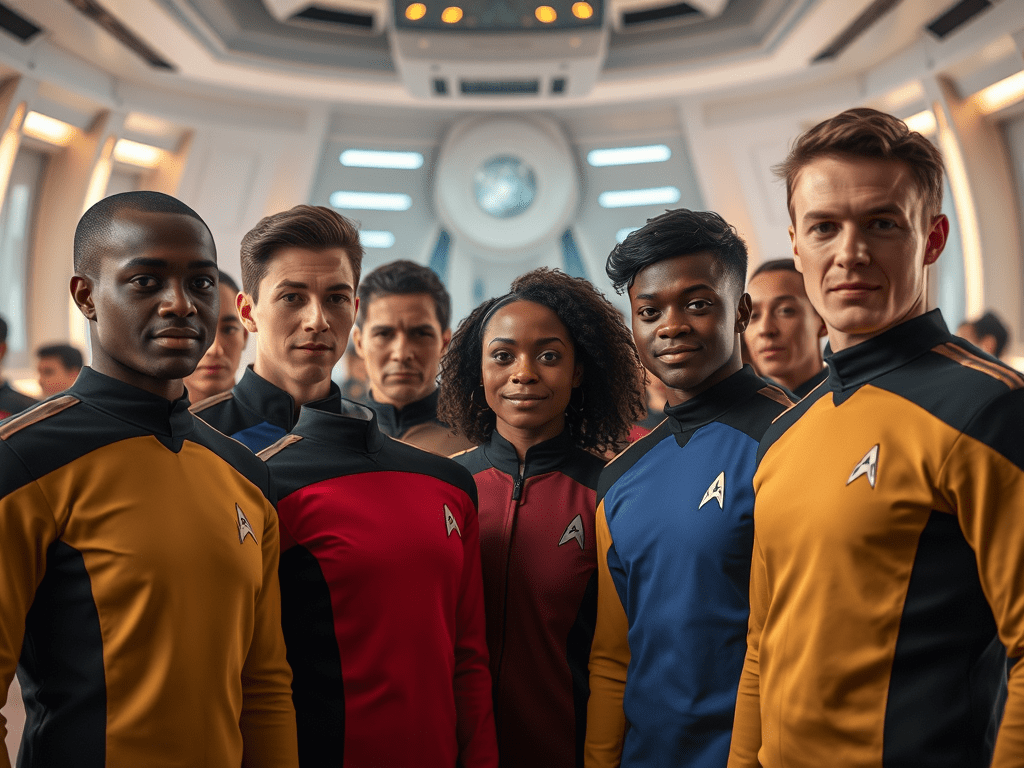
My regular readers will know how much I love Star Trek. And my favorite series is the Strange New Worlds one.
So, I was ecstatic to see that Season 4 is now available on Paramount+. Happy days. So far, the first three episodes have dropped.
Star Trek: Strange New Worlds Season 4 is a vibrant, inventive, and deeply satisfying return that captures the spirit of classic Trek while delivering bold genre swings, strong character work, and pure adventure. Premiering on Paramount+ on July 23, 2026, the 10-episode season (releasing weekly through a September 24 finale) picks up with Captain Christopher Pike and the USS Enterprise crew continuing their exploratory missions in the years before The Original Series. Showrunners Akiva Goldsman and Henry Alonso Myers double down on the series’ episodic strengths—each outing offering a distinct tone and style—while deepening the ensemble and leaning into hope, ethics, friendship, and wonder. Early critical reception has been strong (including an initial perfect Rotten Tomatoes score that settled into Certified Fresh territory), with many calling it reinvigorated and among the show’s best work.
The season opens with “Valles Marineris,” a thrilling time-travel adventure that flings the Enterprise 65 million years into the past amid a stellar storm. What follows mixes dinosaurs (with impressive effects and practical elements), first-contact diplomacy with a warrior culture, moral dilemmas about interfering with history, and Pike confronting his own path and predetermined future. Anson Mount anchors it with quiet intensity and moral clarity, while guest star Saffron Burrows delivers a memorable counterpart. It’s ambitious, bittersweet, philosophically rich in classic Trek fashion (echoing themes from episodes like “The City on the Edge of Forever”), and a fun, high-concept kickoff that balances action, wonder, and character.
“The Griffin Incident,” shifts hard into psychological horror and body horror as Spock, La’an, and a returning young James T. Kirk (Paul Wesley) investigate a derelict Federation ship. It’s tense, visually striking, and unflinching, using the isolated setting and escalating hallucinations to probe the characters’ deepest fears and conflicts (including Spock’s dual nature and Kirk’s emerging sense of responsibility). Christina Chong, Ethan Peck, and Wesley shine in the high-stakes intensity, delivering one of the franchise’s more visceral standalone tales while advancing relationships. This is one of the best episodes of Star Trek every, right up there with Picard’s interactions with the Borg.
“Human Best Friend” provides welcome levity as a shore-leave comedy (with clear nods to TOS “Shore Leave” and hangover-style antics). The crew’s overworked bridge officers hit a pleasure planet whose atmosphere has intoxicating effects, leading to chaotic, character-revealing hijinks. It centers a delightful buddy dynamic between Erica Ortegas (Melissa Navia) and Montgomery Scott (Martin Quinn), turning prior friction into mutual respect and growth, while giving Spock and Kirk further bonding moments. Silly by design yet grounded in friendship, teamwork, and the crew’s need to blow off steam, it’s pure Strange New Worlds charm.
What elevates Season 4 is the consistent excellence of the cast and the freedom to experiment. Mount’s Pike remains a standout—reflective, principled, and human—while Rebecca Romijn’s Number One, Peck’s Spock, Jess Bush’s Chapel, Celia Rose Gooding’s Uhura, Babs Olusanmokun’s M’Benga, and the rest of the ensemble get meaningful moments and pairings. Wesley’s Kirk continues to integrate naturally, and returning guests like Carol Kane’s Pelia add texture. The showrunners emphasize pure episodic storytelling without a single overarching “big bad,” allowing for cowboys, black holes, dinosaurs, haunted ships, comedy, and more (including a planned Jim Henson’s Creature Shop puppet episode). Production values remain high, the writing mixes sincerity with playful genre pastiche, and the hopeful, exploratory ethos feels reenergized.
It ranks among the more lively and memorable runs, giving every performer room to shine across adventure, horror, drama, and comedy. Minor notes about tonal shifts or underdeveloped threads in a highly episodic structure don’t overshadow the overall joy and quality.
As the penultimate season (with a shortened final Season 5 already ordered to bridge toward TOS), Season 4 feels like a celebration of what makes Strange New Worlds special: a crew worth spending time with, strange new worlds and ideas, ethical questions, and the enduring optimism of Starfleet. It’s peak modern Trek—entertaining, thoughtful, and endlessly rewatchable.
Five stars out of five from me.