
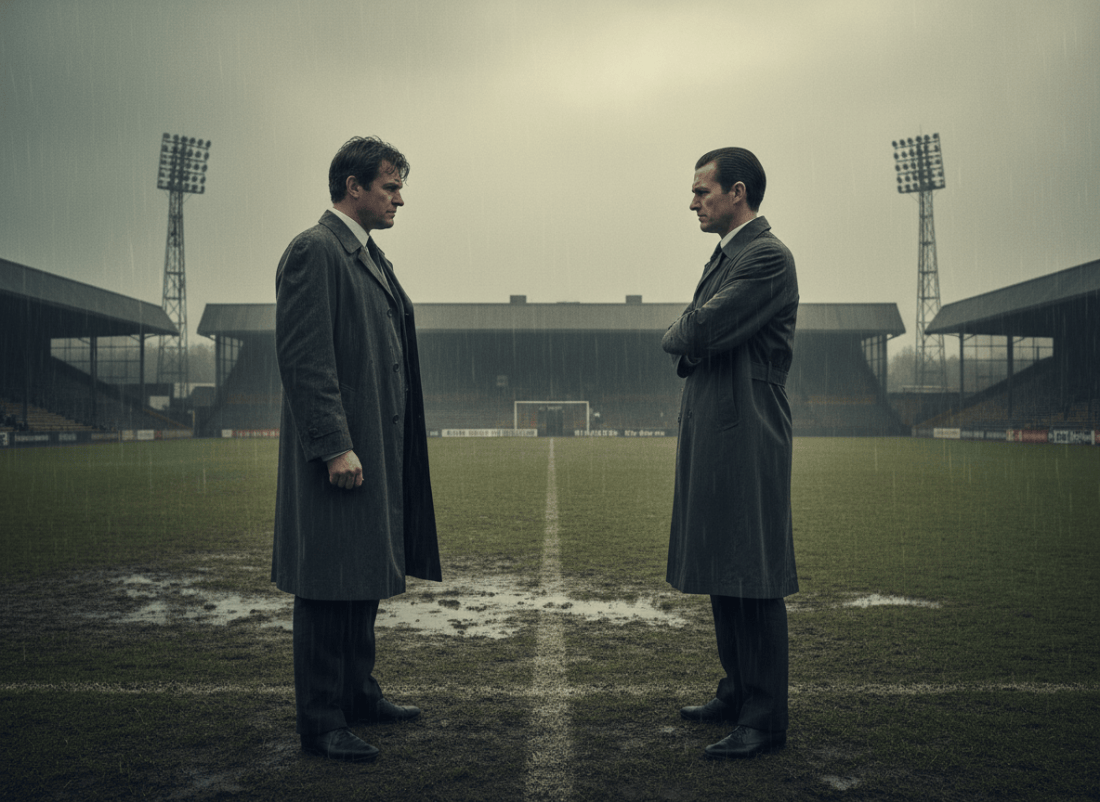
I finished watching this yesterday. In 1974, Brian Clough walks into Elland Road as the new manager of Leeds United, the champions he has spent years calling dirty, cynical, and unworthy. Don Revie has just left for England. The players are still Revie’s men. Peter Taylor, Clough’s indispensable partner, is not there. Forty-four days later, Clough is gone. The film and book both cut that short, doomed tenure against the earlier Derby County years, when Clough and Taylor turned a modest Second Division side into champions. The contrast is the engine: the rise explains the fall, and the fall makes the rise feel dangerous rather than merely triumphant.
What makes things more interesting from my perspective was that Johnny Giles was one of the Leeds players. He was a great pundit that I’m very familiar with so I was curious how he would be portrayed. And well, he isn’t really. Barely says a word but is something of a presence all the same. So, what did Giles think?
On the film specifically he said it was “a misinterpretation of the misinterpretation” of an already made-up book. He also called the portrayal of Clough “dreadful” and “scandalous”: Clough was shown as a raving lunatic who smashed Don Revie’s desk and drank heavily, none of which, Giles said, happened. He did not get on with Clough at Leeds (he found him rude and arrogant) but still felt the depiction was cruel to Clough and unfair to his family, who could not sue because Clough was dead. That, he said, was a major reason he took legal action himself: he was the only living person among those he felt were wronged who could do so.
Not exactly a ringing endorsement.
Still, I quite enjoyed it. It is barely a sports movie in the usual sense. There is mud, crowd noise, and the sour glamour of 1970s English football, but the real action happens in dressing rooms, boardrooms, hotel corridors, and the space between two men who need each other and cannot say so cleanly. Hooper and screenwriter Peter Morgan understand that Clough’s mouth was both his genius and his trap. The film is funny without becoming a joke, sharp without becoming a hatchet job, and surprisingly tender about the Clough–Taylor partnership. That relationship — part marriage, part double act, part management system — is the emotional centre, and Timothy Spall gives Taylor a wounded loyalty that makes Clough’s isolation feel costly rather than merely self-inflicted.
Michael Sheen is extraordinary. He gets the walk, the grin, the sudden freeze of the eyes, the way Clough could turn a compliment into a dare. More importantly, he gets the insecurity under the swagger. This is not a waxwork impression. It is a portrait of a provincial outsider who decided the world would have to fit him, then discovered that Leeds would not. Colm Meaney’s Revie is the perfect counterweight: padded, watchful, already a myth in his own club. Jim Broadbent, as Derby chairman Sam Longson, supplies the boardroom comedy and the slow-burn resentment of a man who backed a miracle and then wanted to own it. Around them, the film has the grain and damp of the period without drowning in nostalgia. The pitches look like battlefields. The offices look like places where careers actually end.
The themes travel far beyond Leeds. This is a story about succession, about what happens when a new leader inherits a family rather than a squad, and about the thin line between principle and vanity. Clough wants football to be cleaner, braver, more expansive. He also wants to win the argument with Revie. The film is wise enough to see that those two desires are not the same thing. Hatred, as several reviewers noted, can become a vocation. By the time Clough is telling champions to throw their medals in the bin, the line has stopped being moral instruction and become a man burning the only bridge that might have held.
It is also a love letter, of sorts, to a vanished English game: provincial clubs as civic engines, managers as public entertainers, success as something improvised rather than corporately managed. You do not need to care about the First Division table of 1974. You only need to care about people who cannot stop competing long enough to save themselves.
Three point five stars out of five from me.

