
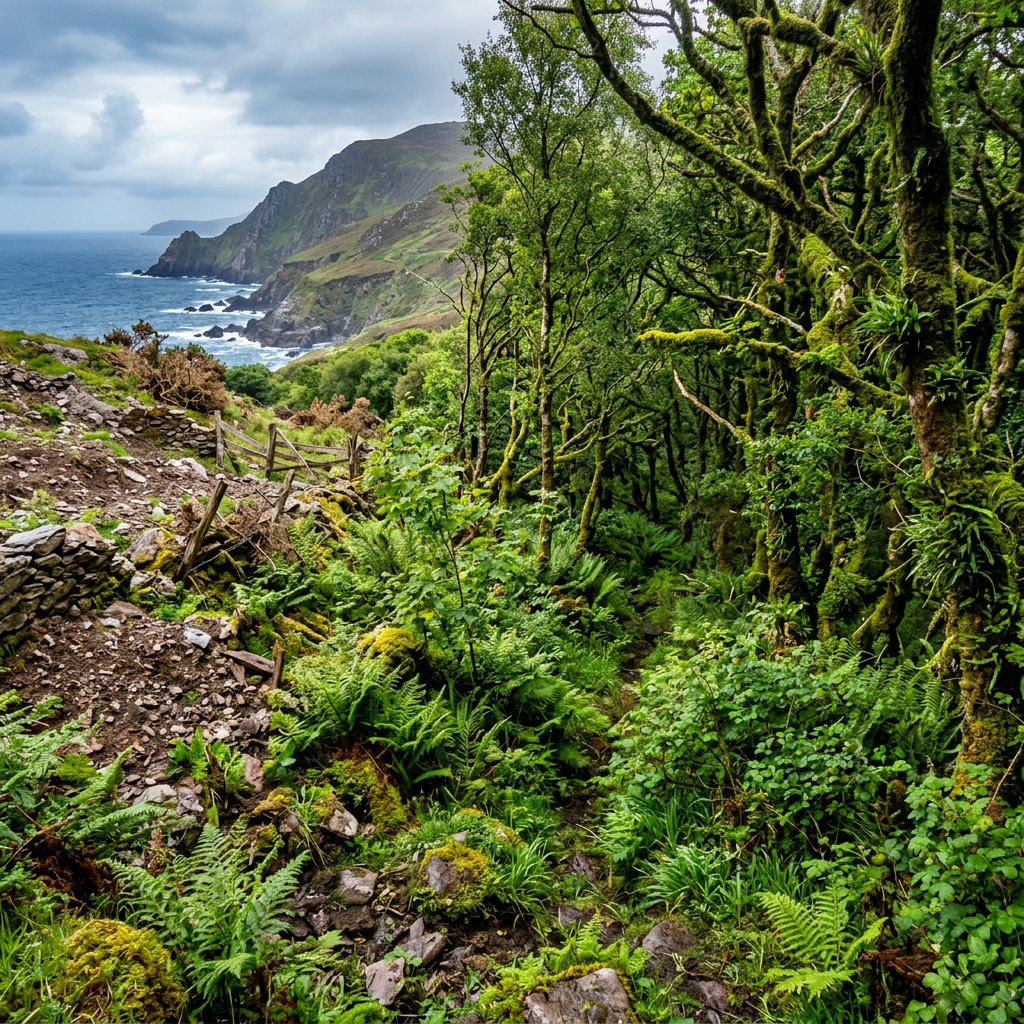
This is an interesting documentary about my home country of Ireland. A bit of background information – almost all of Ireland’s natural forests were cut down by the British. About 12% of the island of Ireland is currently forested, it was only 1% in the early 1900s. However, true native woodland only comprises 2%, and most of this is managed.
n Irish Atlantic Rainforest (directed by Gary Lennon, 2026) is a strikingly beautiful and quietly powerful environmental documentary that transforms a small corner of Ireland into something that feels almost otherworldly.The film centres on Eoghan Daltun, a Dublin-born sculptor, author, and rewilder who in 2009 bought a 73-acre farm on the Beara Peninsula in West Cork.
The land was ecologically damaged—overgrazed by deer and goats and choked with invasive species, particularly rhododendron. His approach was deliberately minimal: he fenced out the grazers, cleared the non-native plants, and then largely stepped back to let nature recover on its own.
The result is the spontaneous return of a temperate Atlantic (or Celtic) rainforest, one of Europe’s rarest and most threatened habitats, complete with moss-draped trees, dense epiphytes, ferns, fungi, and returning wildlife.Lennon’s film is at its strongest visually. Cinematographers Ross Bartley and Brian O’Leary get remarkably close to the forest floor and the living surfaces of trees and rocks. Macro shots of flapped fungi, green-eyed insects, snails, and intricate plant life make the familiar Irish woodland look exotic and alien—lush, intricate, and teeming in a way that invites comparison with more celebrated tropical forests. The seasonal changes and the sheer density of life that emerges once pressure is removed are captured with genuine wonder. These sequences are the film’s greatest asset and frequently feel transcendent.
Daltun himself is an intense, articulate presence. The documentary interweaves his personal backstory—growing up in Dublin, studying sculpture in Italy, restoring a cottage, and eventually choosing radical simplicity on the edge of the Atlantic—with his ecological observations and arguments. He makes a clear, passionate case for passive rewilding and the recovery of native woodland as both an ecological necessity and a source of joy and meaning. Brief contrasts with other landscapes (including sequences elsewhere) underline how distinctive and fragile these Irish temperate rainforests are.
At around 90 minutes, the film sustains its focus without overreaching into heavy-handed advocacy. It is more observational and immersive than didactic, allowing the recovery of the land and Daltun’s lived experience to carry the message. Viewers come away with a vivid sense of what Ireland’s lost woodlands can still become when given space, and with admiration for the patience and restraint required to achieve it.Not every viewer will envy the isolation or the deliberate rejection of modern urban comforts that Daltun has chosen, but few will fail to be impressed by the results or moved by the beauty on screen. The documentary stands as both a celebration of one successful act of ecological restoration and a gentle, hopeful invitation to reimagine our relationship with the Irish landscape.
Five stars out of five for those interested in nature.

