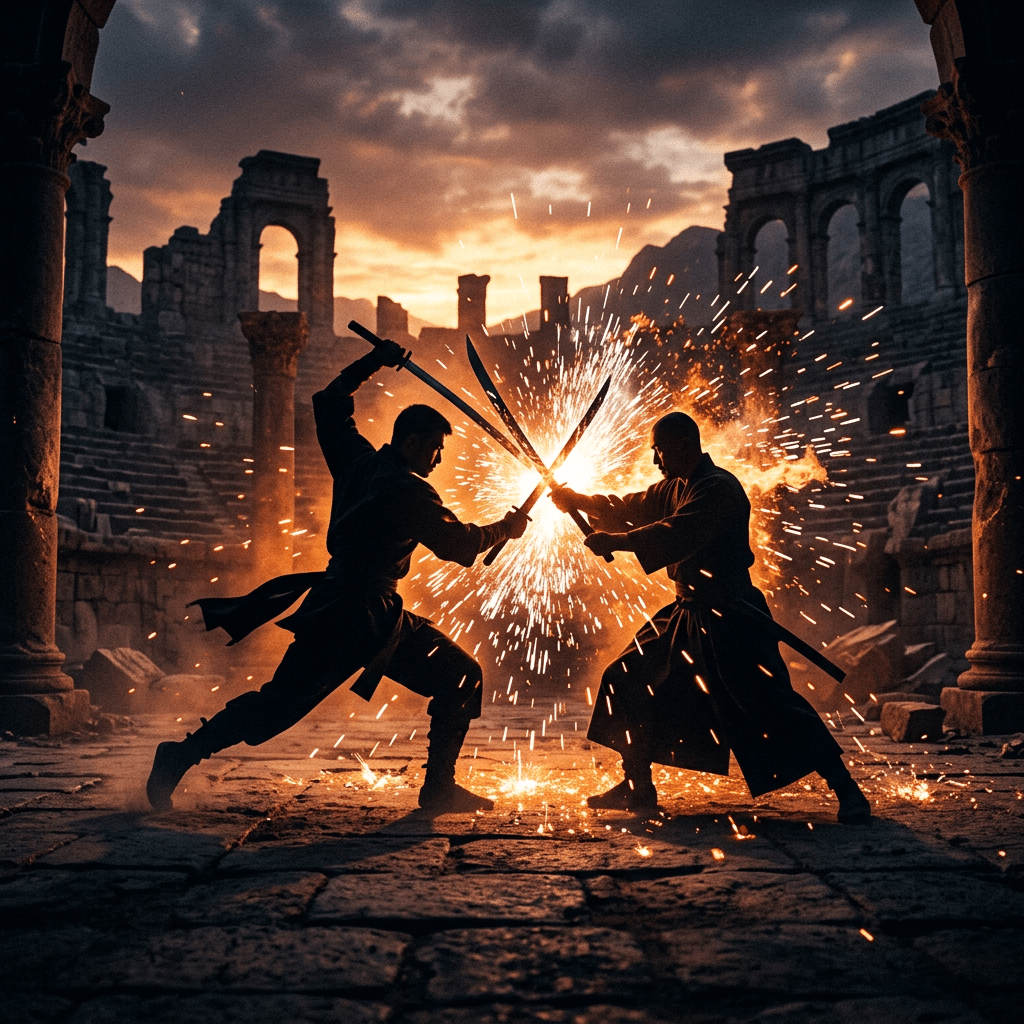
Wheelchair Wars 2 (ii)

The next morning, they rose early. No words were exchanged between them. Audrey was first in the wheelchair. She looked at her roommate, struggling to catch up, sweat dripping from her brow. The sound of chanting from the main hall was audible. Audrey’s mouth opened, but then closed again.

A few minutes later, Jessica was also ready.

“Ready?” Audrey asked.

Jessica nodded, but did not meet her eyes.

When they reached the main hall, their battle chairs were already waiting for them. Audrey felt elated. The others from their group were still to appear.

As Audrey transferred into the battlechair, she could hear jeering.

“You two, think you’re special, do ya?” As Audrey took control of the chair, she surveyed her surroundings. The comment came from Cian. His jaw was clenched, his face crimson. There were two more, on either side of him, of similar disposition.

They were in Falcon B chairs and armed with long swords.

Shouts of “Fight, fight” went out over the great hallway. The others stopped what they were doing, clearing the arena.

“We don’t want to fight,” Jessica implored.

Audrey’s hand was shaking. She thought of what Timothy would say.

The Falcon X was faster and more versatile. She knew what she needed to do.

Review of Join or Die (2023): A Powerful and Hopeful Call for Community

This is an interesting documentary that I came across recently. As we all know, American democracy is looking fairly shaky at the moment. But why? Well, this posits that it’s about diminishing social capital.

Join or Die is a 2023 American documentary film regarding community connections and club participation, based on the work of political scientist Robert Putnam.

The film includes interviews with Hillary Clinton, Pete Buttigieg, Surgeon General Vivek Murthy, Eddie Glaude Jr., Raj Chetty, and Priya Parker.

The documentary Join or Die, directed by Pete Davis and Rebecca Davis, is an insightful and deeply inspiring exploration of one of the most urgent social questions of our time: why are people becoming increasingly disconnected from one another, and what can be done to rebuild a sense of community? Centered on the research and life work of renowned political scientist Robert D. Putnam, the film delivers a compelling blend of history, social science, and human storytelling that makes a powerful case for the importance of civic engagement.

t the heart of the documentary is Putnam’s groundbreaking concept of social capital—the networks of trust and cooperation that bind communities together. His influential book Bowling Alone: The Collapse and Revival of American Community argued that Americans have become increasingly isolated since the mid-20th century, with declining participation in clubs, associations, and civic groups. Join or Die takes this idea and transforms it into a vibrant cinematic narrative, showing how the erosion of these social ties has profound consequences not only for individual well-being but also for democracy itself.

One of the film’s greatest strengths is its accessibility. Rather than presenting Putnam’s research in a dry academic format, the filmmakers weave together archival footage, animated visuals, and personal stories from communities across the United States. This creative storytelling approach brings complex sociological ideas to life, making them both understandable and emotionally resonant. The pacing is energetic and engaging, ensuring that the film remains both informative and entertaining.

Beyond its intellectual depth, Join or Die is ultimately an optimistic film. While it acknowledges the troubling decline in civic participation and trust in institutions over recent decades, it does not dwell on pessimism. Instead, it offers a hopeful and practical vision of renewal. By highlighting grassroots groups, neighborhood initiatives, and local organizations that are rebuilding community bonds, the documentary demonstrates that the solution may be surprisingly simple: people coming together in real life.

Emotionally, the film resonates because it speaks to a universal human need—the desire to belong. In an era defined by digital interaction, loneliness, and social fragmentation, Join or Die reminds viewers that meaningful connections are essential for both personal happiness and collective prosperity. The film suggests that joining a club, volunteering, or participating in community groups can have transformative effects not only on individuals but on society as a whole.

I found it quite interesting, and it gets three stars out of five from me. Hey, no sex or violence.

But what did you think? Let me know in the comments.

The Dinosaurs Series Review: A Thrilling Journey into Prehistoric Times

There is something about the T. rex that brings out my inner child. So it was with great excitement that I started watching The Dinosaurs on Netflix.

The Dinosaurs is an American television nature documentary miniseries produced by Amblin Documentaries and Silverback Films. Executive-produced by Steven Spielberg and narrated by Morgan Freeman, the four-part series focuses on the history of dinosaurs from their appearance in the Triassic period until their demise in the Cretaceous–Paleogene extinction event.

First, Morgan Freeman adds so much to the series with his unforgettable accent -ddinossaursss. But it also has so much more to offer.

The Dinosaurs is one of those rare shows that manages to be both wildly entertaining, educational and surprisingly meaningful at the same time. From the very first episode, it pulls you into a colorful prehistoric world that feels playful, imaginative, and full of personality.

What immediately stands out is the show’s charm. The characters are lovable, expressive, and memorable, each bringing a different kind of humor and heart to the story. The family dynamic is especially engaging—full of funny misunderstandings, heartfelt moments, and the kind of everyday situations that viewers of all ages can relate to. Even though the setting is prehistoric, the themes feel very modern and relatable.

The humor is another major strength. The show strikes a balance between slapstick comedy and clever jokes, offering situational humor that appeals to both younger viewers and adults.

The series consists of four episodes: Rise, Fall, Empire, and Fall.

Fall, of course, is the saddest one. Watching all those poor dinos being cooked brought a tear to my eye.

Go on, it’s a good watch. Four stars out of five from me.

Netflix’s War Machine Review: Big Action, Bigger Robot, Great Results

Alan Ritchson as Ranger 81 in War Machine 2026 Netflix film

Ladies and gentlemen, you know how I love a good sci-fi. And a sci-fi with plenty of action is even better. Well, a proper gem has just been released on Netflix!

War Machine is a 2026 science fiction action film directed, co-produced, and co-written by Patrick Hughes. It stars Alan Ritchson, Dennis Quaid, Stephan James, Jai Courtney, Esai Morales, Keiynan Lonsdale and Daniel Webber.

In Afghanistan, an unnamed Staff Sergeant arrives to help his brother’s broken down convoy. His brother tries to convince him that they should apply to become Army Rangers, when they are attacked by Taliban insurgents. Everyone is killed except the Staff Sergeant, who suffers a knee injury. The Staff Sergeant tries to carry his mortally wounded brother back to base but passes out before making it. When he wakes up in the hospital, he learns that his brother had already died, but he is awarded the Silver Star. This is one part of the film where the visuals could have been better. The background was out of focus. The scenery of Afghanistan was worth getting right.

Two years later, the Staff Sergeant attends RASP to join the 75th Ranger Regiment, and is given the candidate number of 81. 81 excels at training but does not bond with his fellow recruits and refuses the role of team leader, despite his record. After he allows himself to nearly drown during an underwater exercise, regiment leaders Sergeant Major Sheridan and First Sergeant Torres question his mental state over his PTSD and insist he step down from the program to recuperate, but 81 refuses. Sheridan and Torres allow him to advance and assign him team leader for the final exercise, a simulated mission in the forest to destroy a classified aircraft and rescue its pilot. Around that time, reports come out of a suspected asteroid revolving around the planet breaking off in pieces.

During the exercise, the team is startled by an unknown blast in the sky, which knocks out communications, and finds a strange looking object by the creek, which the team believes is the classified aircraft. After detonating it with explosives, it remains undamaged and transforms into a walking machine that starts killing the team. Oh yeah baby! I love it.

War Machine (2026) is a high-octane sci-fi action film that delivers exactly what modern action cinema should: relentless tension, striking visuals, and a compelling hero at the center of a desperate fight for survival.

One of the film’s biggest strengths is the commanding presence of Alan Ritchson in the lead role. As the emotionally scarred but resilient soldier 81, he delivers a performance that balances physical power with vulnerability.

Ritchson brings credibility to the character through demanding stunt work and intense physical scenes, many of which were performed practically during filming. It makes it all the more compelling.

Where War Machine truly shines is in its action sequences. Director Patrick Hughes crafts battles that feel raw and immediate, with soldiers navigating forests, rivers, and rugged terrain while being pursued by an unstoppable alien machine.

The film’s use of practical stunts and real explosions adds authenticity rarely seen in streaming action films. Scenes such as rappelling over rapids or underwater endurance tests push the actors physically and create a visceral sense of danger.

My favorite part was the chase between the armored car and the machine. It was edge of the seat stuff.

The robotic antagonist is also a highlight. Its mechanical design and relentless pursuit give the film a thrilling “survival horror” edge, reminiscent of classic sci-fi action films where humans must outsmart a technologically superior enemy.

And the good news is that there are more aliens on the way, so there’s room for a sequel.

Have you seen it? Let me know what you think. Five stars out of five from me.

The Outlaw King Review: A Gripping Tale of Scottish Independence

There’s something about medieval Scots fighting the English that warms the heart. “Freedom” sounds great, but any reason to fight the old enemy is good enough in truth. Well, from a film perspective. I love English people, really. So when I saw that this was available on Netflix, I pressed play.

The Outlaw King is an electrifying and emotionally resonant historical epic set in 1304 that brings Robert the Bruce’s story to life with striking authenticity and intensity. Directed by David Mackenzie and led by a commanding performance from Chris Pine, this film stands as a gripping portrayal of Scotland’s fight for independence — raw, human, and deeply inspiring.

From the very first frame, the film immerses viewers in the harsh, mud-soaked reality of medieval warfare. Unlike glossy historical dramas, The Outlaw King embraces realism. It also predates the CGI nonsense plaguing modern films. The battle sequences are visceral and unflinching, especially the climactic confrontation at the Battle of Loudoun Hill, which is staged with breathtaking choreography and tension. The long, chaotic tracking shots during combat create a sense of immediacy that makes you feel as if you’re right there on the battlefield.

Chris Pine delivers one of the strongest performances of his career. His portrayal of Robert the Bruce is layered and compelling — not a flawless hero, but a determined and conflicted leader who grows into his destiny. Pine captures the vulnerability, resolve, and quiet intensity of a man who risks everything for freedom. His Scottish accent is impressive, and his physical commitment to the role adds authenticity.

The supporting cast is equally strong, particularly Florence Pugh as Elizabeth de Burgh. Pugh brings intelligence and emotional weight to her role, portraying a woman whose strength matches the film’s epic scope. The chemistry between her and Pine adds heart to a story otherwise dominated by political tension and warfare.

Visually, the film is stunning. The rugged Scottish landscapes — sweeping highlands, mist-covered hills, and medieval castles — are captured with moody cinematography that enhances both the beauty and brutality of the setting. The natural lighting and muted color palette reinforce the grounded tone, making everything feel lived-in and historically authentic.

What truly sets The Outlaw King apart is its focus on resilience and leadership. Rather than romanticizing rebellion, the film shows the cost of resistance — betrayal, loss, hardship — and makes Robert’s eventual victories feel earned. It’s a story about persistence in the face of overwhelming odds, and it resonates far beyond its historical setting.

For fans of historical dramas, war epics, or character-driven storytelling, The Outlaw King is a must-watch. It’s bold, intense, and emotionally stirring — a film that honors its history while delivering cinematic excitement. A powerful reminder that freedom is rarely won without sacrifice.

The one drawback to the film, unlike the classic Braveheart, this feels like a war between nobles, the top tier in each country. It doesn’t feel to me, watching it, that this is a battle of your average Scot.

For that reason, it gets three stars out of five from me.

Unforgettable Performances: Jodie Foster’s Best Roles

My earliest memory of watching Jodie Foster was as Clarice Starling, an FBI trainee in one of my favorite films of all time – The Silence of the Lambs. Her acting, and that of Anthony Hopkins, was unforgettable. In particular, the conversations between Clarice and Dr. Hannibal Lecter.

For many years, I had thought that was her breakout role. But I was wrong.

Foster first stunned audiences with her haunting performance in Taxi Driver, directed by Martin Scorsese, as a child prostitute. At just 14 years old, she delivered a performance of extraordinary emotional intelligence and control, earning an Academy Award nomination. It was immediately clear she was not a typical child actor but a serious dramatic force. Set in a decaying New York City following the Vietnam War, it stars Robert De Niro as veteran Marine and taxi driver Travis Bickle, whose mental state deteriorates as he works nights in the city.

Jodie Foster has since built one of the most intelligent, fearless, and enduring careers in modern cinema. From child prodigy to two-time Academy Award winner to respected director, her body of work reflects an artist who consistently chooses depth over glamour and complexity over cliché.

Throughout the 1980s and 1990s, Foster solidified her reputation for portraying fiercely intelligent, resilient women. Her Oscar-winning role in The Accused showcased her extraordinary courage and vulnerability, anchoring a difficult, socially significant story with nuance and dignity. She followed that triumph with perhaps her most iconic performance as Clarice Starling in the previously mentioned The Silence of the Lambs.

What distinguishes Foster’s career is her commitment to intelligence—both her own and that of her audience. In films like Contact, directed by Robert Zemeckis, she brought emotional gravity to philosophical science fiction, grounding big ideas in human vulnerability. Even in high-concept thrillers such as Panic Room, she elevated genre material through subtle character work and psychological realism.

Beyond acting, Foster has also proven herself an accomplished director. With films like Little Man Tate and The Beaver, she demonstrated a thoughtful, character-driven approach behind the camera, often exploring themes of identity, intelligence, and emotional isolation—subjects that have consistently fascinated her throughout her career.

Another hallmark of Foster’s legacy is longevity. The most recent work I’ve seen her in was the fourth season of True Detective. It is set in the fictional town of Ennis, Alaska, north of the Arctic Circle, during polar night. It follows the investigation of the disappearance of eight men from a research station. The season stars Jodie Foster and Kali Reis as Detectives Liz Danvers and Evangeline Navarro.

Foster’s character is central to each episode. Despite her increasing age, the inner beauty shines through in a determined, eerie performance.

Lets hope she keeps going for another few decades.

The Rise of Judit Polgár: Insights from ‘Queen of Chess’

My dear readers, anybody who knows me for real knows how much I love chess. And yes, it is a sport. Everyday, I go to Chess.com and make a few moves. So, I immediately felt upbeat when there was a chess documentary to watch.

Queen of Chess is a 2026 documentary film that explores the life and career of Hungarian chess grandmaster Judit Polgár. It focuses on her father’s efforts to train her and her two sisters to become chess grandmasters, and on the saga of her multiple and intense matches against the then-formidable world champion Garry Kasparov. It was directed by Rory Kennedy.

It is a captivating and inspiring documentary that transcends the world of competitive chess to tell a deeply human story about ambition, resilience, and the pursuit of excellence. From its opening moments, the film draws viewers into the intellectual intensity and emotional stakes of a game often misunderstood as purely cerebral, revealing instead a landscape rich with drama, creativity, and personal sacrifice.

One of the documentary’s greatest strengths is its storytelling. Rather than focusing solely on wins, rankings, and tournaments, it explores the protagonist’s journey with nuance and empathy. We see not just a brilliant strategist at the board, but a person navigating pressure, expectations, and identity in a field historically dominated by men. The film deftly balances moments of triumph with vulnerability, making the narrative both powerful and relatable.

A drawback for chess lovers is that it doesn’t go into the matches in detail. It does reference what openings are played, the fact that Kasparov almost always played the Sicilian, for instance.

The documentary gives a broad perspective. It contextualizes Judit Polgár’s achievements within the cultural and social realities of the chess world, touching on themes of gender, representation, and the cost of greatness. These elements elevate the film beyond a sports documentary, transforming it into a thoughtful reflection on what it means to challenge boundaries and redefine what is possible.

Four stars out of five from me.

M3GAN 2.0: Sequel Analysis and Performances

So, the other film I watched on a very busy Sunday was this gem, M3ghan 2.0. I have to be honest, I haven’t seen the original, but it looked like it would be worth watching. M3GAN 2.0 is a 2025 American science fiction action film written and directed by Gerard Johnstone from a story he co-wrote with Akela Cooper. A sequel to the 2022 film M3GAN and the second installment in the M3GAN franchise, the film stars Allison Williams, Violet McGraw, Ivanna Sakhno, and Jemaine Clement, with Amie Donald physically portraying M3GAN while Jenna Davis voices the character. Jason Blum and James Wan return as producers through their respective Blumhouse Productions and Atomic Monster.

What immediately stands out is how the film deals with its central ideas about artificial intelligence, control, and human dependence on technology. M3GAN is no longer just a creepy novelty; she’s a fully realized presence whose intelligence, adaptability, and unsettling logic drive the story forward. The screenplay smartly plays with shifting alliances and moral ambiguity, making the audience constantly reassess whether M3GAN is purely a villain—or something more complicated and unsettling than that.

U.S. Army colonel Sattler, head of a secret branch of the Pentagon specializing in new technologies, gives a demonstration of AMELIA,[a] an android designed for infiltration and assassination missions and built using technology copied from the original M3GAN. During her mission, however, AMELIA reveals to Sattler that she is self-aware and escapes from his control.

In a strange twist, M3ghan, who survived by making a backup in a smart home from the happenings of the first film. becomes the best hope of stopping her. This reminded me of the Terminator franchise and the idea that one could outgrow one’s original programming.

The performances remain a strong point. Allison Williams brings added emotional weight and maturity to her role, reflecting a character shaped by past trauma and hard-earned lessons. Violet McGraw continues to impress, grounding the story with genuine emotional stakes. And M3GAN herself—through a blend of physical performance, voice work, and effects—is sharper than ever: funny, menacing, and oddly charismatic in a way few horror icons manage.

Stylistically, M3GAN 2.0 is slick and energetic. The action sequences are confidently staged, the pacing rarely drags, and the film knows exactly when to lean into camp and when to pull back for tension. It embraces its identity unapologetically, delivering moments that are thrilling, darkly funny, and undeniably crowd-pleasing.

Four stars out of five from me.

Liam Neeson excels in the classic film Non-Stop

What better way to spend my Sunday, readers, than with Liam Neeson? Non-Stop is a 2014 action thriller film directed by Jaume Collet-Serra, co-produced by Joel Silver, and starring Liam Neeson and Julianne Moore. I’m pretty sure I’d seen it before, but got roped into watching it again.

Liam Neeson is perfectly cast as Bill Marks, a flawed, weary air marshal whose personal demons make him both relatable and intriguingly unreliable. His performance grounds the film emotionally, adding depth to what could have been a straightforward action role. Neeson’s restrained intensity makes every decision feel risky, and the script smartly uses his character’s vulnerability to blur the line between hero and suspect. The supporting cast—including Julianne Moore and Michelle Dockery—adds further layers of suspicion, making nearly every passenger feel like a potential threat.

The high-altitude thriller proves how gripping a well-executed, old-school suspense film can still be. Set almost entirely aboard a transatlantic flight, the movie wastes no time pulling the audience into its central mystery: a U.S. air marshal receives anonymous messages threatening to kill a passenger every 20 minutes unless a massive ransom is paid. From that chilling premise, the film delivers relentless tension, clever twists, and a constant sense of paranoia that keeps you guessing right up to the end.

What truly elevates Non-Stop is its pacing and atmosphere. Director Jaume Collet-Serra expertly uses the confined airplane setting to amplify tension, turning everyday objects and casual interactions into sources of dread. The film balances smart plotting with visceral action, offering just enough misdirection to keep viewers engaged without feeling gimmicky. By the time the final revelations land, the payoff feels earned rather than forced.

Overall, Non-Stop is an entertaining, edge-of-your-seat thriller that understands exactly what it wants to be. It’s a sharp, suspenseful ride that showcases Liam Neeson at his best and proves that a single setting, when used creatively, can deliver big thrills.

It gets a score of four stars out of five from me. Keep an eye out for it.

Star Trek: Starfleet Academy Review – A New Era of Cadets

My dear readers, a new Star Trek series is here! Star Trek: Starfleet Academy is the 12th Star Trek series and part of executive producer Alex Kurtzman’s expanded Star Trek Universe. Set in the 32nd century, the far-future time period that was introduced in the later seasons of the series Star Trek: Discovery (2017–2024), Starfleet Academy follows the first new class of Starfleet cadets in over a century as they come of age and train to be officers. This is the period after “The Burn” that almost totally destroyed the Federation

Sandro Rosta, Karim Diané, Kerrice Brooks, George Hawkins, and Bella Shepard portray Starfleet Academy cadets, starring alongside Holly Hunter and Zoë Steiner, as well as Tig Notaro and Oded Fehr, who are reprising their roles from Discovery, and Robert Picardo returning as the character of the Doctor from other previous series.

So far, I’ve only watched the first episode, and I think it will gain traction. From a kind, non-violent Klingon to the first holographic cadet, it could get very interesting. The ensemble cast is introduced with care, giving each character a clear emotional hook without overwhelming the audience. Their interactions feel lived-in and sincere, suggesting long arcs of growth rather than quick archetypes. Importantly, the episode allows vulnerability to coexist with ambition; these cadets are capable and driven, but also uncertain, impulsive, and still figuring out who they want to be. That balance makes their journey immediately compelling.

One of the episode’s greatest strengths is its focus on perspective. By centering the story on cadets at the very beginning of their Starfleet journey, the show reclaims a sense of awe that longtime fans may remember from earlier Trek, while also making that wonder feel fresh. The Academy isn’t just a school—it’s presented as a crucible where personal histories, cultural differences, and ethical ideals collide. The premiere smartly uses this setting to explore what Starfleet represents in a changing galaxy, and why those values still matter.

On a more negative note, I feel the show could do with some eye candy. Most are plain, there is no seven of nine vibes, which I think is a pity.

Overall, the premiere succeeds because it’s hopeful. In a television landscape often dominated by cynicism, Star Trek: Starfleet Academy leans into the idea that learning, empathy, and shared ideals can genuinely shape a better future.

So far, I give the show three stars out of five. I’m looking forward to watching more.

Any other Trekkies out there? Leave a comment.

And don’t forget to subscribe.